
Post
The Joker: Year One
May
The Joker: Year One
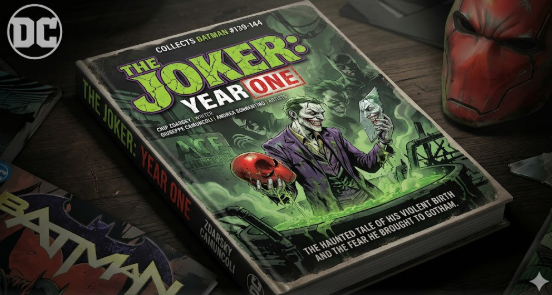
To complete the trilogy of dark, transformative “Year One” style narratives, we must look at The Joker: Year One (featured in Batman #142–144, 2024). Written by Chip Zdarsky with art by Giuseppe Camuncoli and Andrea Sorrentino, this story serves as a modern “product” of retroactive continuity, filling the gaps in the Clown Prince of Crime’s origin.
While The Dark Knight Returns looked at the end and Wonder Woman: Blood reimagined the source, Joker: Year One deconstructs the madness itself.
I. The Premise: The Gap Between the Man and the Monster
Most Joker origins begin and end with The Killing Joke—a failing comedian falls into a vat of chemicals and comes out insane. Joker: Year One focuses on the immediate aftermath. It asks: How does a man who just lost everything, including his face and his mind, learn to become a master criminal?
The Three Jokers Connection
The story leans into the “Three Jokers” concept, suggesting that the Joker we know didn’t just happen by accident; he was forged through a combination of chemical trauma and psychological manipulation.
II. The “Product” of Training: Daniel Captio
One of the most fascinating additions to the lore is the character Daniel Captio. In Batman’s own “Year One” lore, Captio was the man who taught Bruce Wayne how to compartmentalize his pain and use his mind as a weapon.
In Joker: Year One, we learn that Captio also found the Joker shortly after his transformation.
The Dark Mirror: Captio sees the Joker as his “greatest work.” If Bruce Wayne is the man who mastered his mind to create order, the Joker is the man who mastered his mind to create total chaos.
Psychological Architecture: Captio helps the Joker navigate his fractured psyche, essentially “building” the persona that would eventually terrorize Gotham for decades.
III. Narrative Structure: The Two Timelines
The story is told through two alternating perspectives that enhance the “product” of the character’s legacy.
The Past (Year One): A gritty, desaturated look at a shivering, pale man in a trench coat trying to find his footing in Gotham’s underworld. It feels like a classic mobster movie seen through a fever dream.
The Future (The Red Mask): A haunting, horror-infused look at a future where a “Joker Virus” has infected the world. This timeline highlights the Joker not just as a man, but as an inevitable infection of the human spirit.
IV. Themes of Identity and Choice
While The Killing Joke suggested that “one bad day” can turn anyone into the Joker, Joker: Year One adds a layer of agency.
The Choice of Madness: The story suggests that the Joker actively chooses his insanity every morning. He isn’t just a victim of chemicals; he is a scientist of his own suffering.
The Absence of a Name: The story carefully avoids giving him a definitive “real name,” preserving the mystery while making his transformation feel more grounded and methodical.
V. Visual Style: Camuncoli vs. Sorrentino
The art is a crucial part of this product’s impact:
Giuseppe Camuncoli handles the “Year One” era with a style that pays homage to David Mazzucchelli (the artist of the original Batman: Year One). It is grounded, dirty, and architectural.
Andrea Sorrentino handles the future sequences with his signature abstract, high-contrast style. It feels disjointed and terrifying, perfectly capturing the Joker’s internal state.
VI. Comparison: The “Year One” Trilogy
| Story | Focus | Core Philosophy |
| Batman: TDKR | Survival & Legacy | The Will to Power. |
| Wonder Woman: Blood | Family & Divinity | The Will to Love (despite Blood). |
| The Joker: Year One | Trauma & Chaos | The Will to Destroy. |
VII. Conclusion: The Final Piece of the Puzzle
The Joker: Year One completes a cycle of storytelling. If The Dark Knight Returns showed us that Batman is an eternal force, and Wonder Woman: Blood showed us that Diana is a divine one, Joker: Year One reminds us that the Joker is a human one.
By showing the work, the training, and the agonizing mental discipline it took for the Joker to become “The Joker,” the story makes him even more terrifying. He isn’t just a clown who fell into a vat; he is a man who looked into the abyss, saw Bruce Wayne looking back, and decided to laugh.
Which of these “Redefinition” stories do you find most compelling? Is it the Aging Legend (Batman), the Demigod Daughter (Wonder Woman), or the Cultivated Madman (Joker)?
Tiếp nối mạch phân tích về những “sản phẩm” (products) mang tính định hình lại biểu tượng siêu anh hùng, chúng ta sẽ đi sâu vào phần cuối cùng và cũng là phần đen tối nhất: The Joker: Year One.
Dưới đây là bài phân tích chi tiết bằng tiếng Anh (kèm các thuật ngữ chuyên môn) về cách câu chuyện này hoàn thiện “Tam giác vàng” cùng với Batman: TDKR và Wonder Woman: Blood.
The Anatomy of Insanity: A Deep Dive into The Joker: Year One
While Batman: The Dark Knight Returns dealt with the end of a legend, and Wonder Woman: Blood reimagined the origin of a goddess, The Joker: Year One (2024) focuses on the transition from man to monster. Written by Chip Zdarsky, this story acts as a “missing link” in the DC product line, bridging the gap between the tragic victim in the chemical vat and the criminal mastermind who would haunt Gotham for eternity.
I. The Narrative Product: Filling the “Killing Joke” Vacuum
For decades, Alan Moore’s The Killing Joke was the gold standard for Joker origins. However, it left a massive gap: How does a failed comedian with no combat training or criminal genius suddenly become the “Clown Prince of Crime”?
The “Training” of a Madman
The primary “product” of Joker: Year One is the introduction of Daniel Captio. In Batman’s lore, Captio was the man who taught Bruce Wayne how to “partition” his mind—to box away pain and fear.
The Dark Mirror: We discover that Captio also trained the Joker.
The Intellectualization of Chaos: This changes the Joker from a “random accident” into a “disciplined disaster.” He didn’t just go crazy; he studied insanity. He learned how to make his madness a weapon, just as Bruce learned to make his grief a weapon.
II. The Dual-Timeline Product: The Virus and the Man
Zdarsky utilizes a complex narrative structure that keeps the reader off-balance, mirroring the Joker’s own fractured mind.
1. The Past (The “Year One” Era)
Set immediately after the “Red Hood” falls into the chemicals at Ace Chemicals. The art by Giuseppe Camuncoli is gritty and grounded.
The Fragility of Evil: We see a Joker who is shivering, scared, and physically decaying. This humanizes him just enough to make his eventual transformation into an unfeeling monster more terrifying.
2. The Future (The “Red Mask” Virus)
The story jumps to a future where a “Joker Virus” threatens to infect the very concept of Gotham.
The Artistic Shift: Andrea Sorrentino uses abstract, experimental layouts to show that the Joker is no longer a person—he is an ideological infection.
III. Themes of Identity: The “Three Jokers” Legacy
The book addresses the controversial “Three Jokers” theory—the idea that there isn’t just one Joker, but three distinct personalities (The Criminal, The Clown, and The Comedian).
The Synthesis: Year One suggests that the Joker created these personas as a defense mechanism to survive Daniel Captio’s brutal psychological training.
The Product of Choice: Unlike Wonder Woman: Blood, where Diana’s identity is tied to her biological “blood,” the Joker’s identity is a construct. He chooses to have no name. He chooses to have no past. He is the ultimate “self-made” product of the DC Universe.
IV. Comparison: The “Redefinition” Trilogy
To understand the scope of these three works, we can compare them across key metrics:
| Feature | Batman: TDKR | Wonder Woman: Blood | The Joker: Year One |
| Central Conflict | Man vs. Authority | Daughter vs. Dynasty | Man vs. Self (Madness) |
| Philosophical Root | Stoicism & Will | Truth & Empathy | Nihilism & Chaos |
| Visual Tone | Jagged, Heavy, Gritty | Elegant, Fluid, Horrific | Experimental, Abstract |
| Key Innovation | The “Aging” Hero | The “Demi-god” Origin | The “Scientific” Insanity |
V. Why The Joker: Year One Matters in 2026
In our current cultural landscape, we are obsessed with “prequels” and “origin stories.” However, The Joker: Year One succeeds because it doesn’t give us all the answers. It preserves the mystery while adding depth.
It tells us that the Joker is not just Batman’s opposite because they both wear masks. They are opposites because they were both students of the same teacher (Captio). They both looked into the abyss of human suffering; Batman decided to build a wall around it, while the Joker decided to turn the abyss into a playground.
VI. Final Conclusion: The Trinity of Modern Myths
By examining Batman: TDKR, Wonder Woman: Blood, and The Joker: Year One, we see a complete picture of the DC “Product” at its highest level:
Batman represents the Human Will: The refusal to stop fighting even when the body is old.
Wonder Woman represents Divine Grace: The ability to choose love and family over a violent heritage.
The Joker represents Pure Chaos: The realization that the world makes no sense, and the only sane response is to laugh.
These three stories are more than just comics. They are the “Sacred Texts” of modern mythology, proving that even after 80 years, these characters can still be broken, reshaped, and made new.
This concludes our deep dive into these three pillars of comic book storytelling. Would you like to discuss another character’s “Year One” (like Superman: Year One by Frank Miller) or perhaps look at how these three characters interact in a specific event like Kingdom Come?
