Post
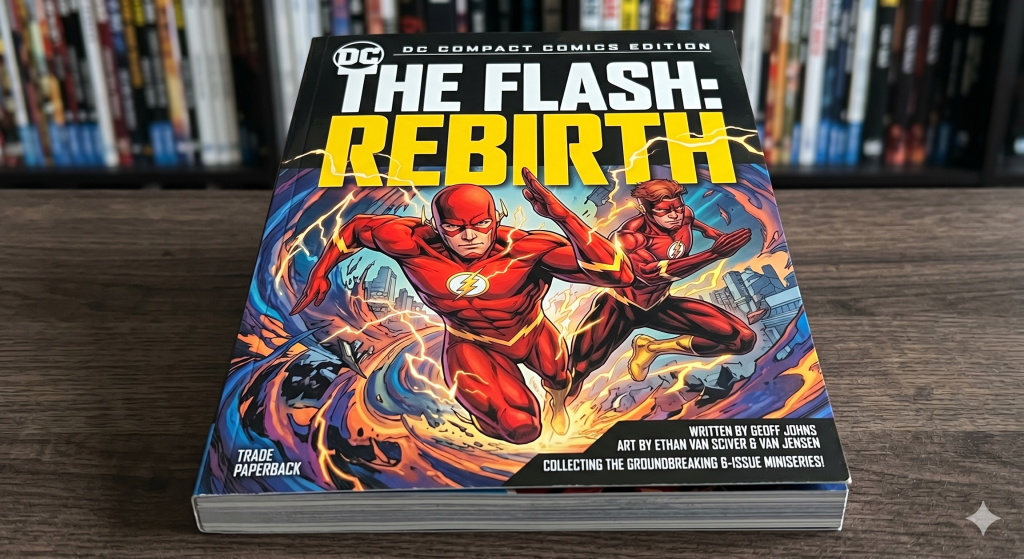
The Flash: Rebirth
May
The Flash: Rebirth
Continuing our deep-dive into the “products” that redefined the DC pantheon, we move from the gritty realism of Batman and the mythological horror of Wonder Woman to the high-concept science fiction of The Flash: Rebirth (2009).
While the other stories we discussed focused on “Year One” or “The End,” The Flash: Rebirth—written by Geoff Johns and illustrated by Ethan Van Sciver—is about Resurrection. It is the story of how Barry Allen, the Silver Age Flash, returned from the dead to reclaim his title as the “Engine of the Universe.”
I. The Context: The Return of the Saint
For 23 years (from 1985 to 2008), Barry Allen was dead. He had sacrificed himself in Crisis on Infinite Earths to save the multiverse, becoming a “Saint” of the DC Universe. His protégé, Wally West, had taken over the mantle and become the Flash for an entire generation of readers.
The “product” goal of Rebirth was twofold:
Re-establish Barry Allen for a modern audience.
Codify the Speed Force as a fundamental law of physics in the DC Universe.
II. The Plot: The Curse of the Speed Force
The story begins with Barry Allen struggling to integrate back into life. He feels like a man out of time. However, his return isn’t just a happy miracle; it is a catastrophe.
The Black Flash Transformation
In a shocking twist, Barry begins to turn into the Black Flash—the personification of death for speedsters. Whenever he touches another speedster, they risk being consumed or killed. Barry believes he was brought back by mistake and tries to run back into the Speed Force to sacrifice himself again.
The Architect of Agony: Eobard Thawne
The true antagonist is revealed to be Professor Zoom (The Reverse-Flash). In a masterstroke of retroactive continuity (retcon), Johns reveals that Thawne didn’t just come back from the future; he created Barry’s return. Thawne manipulated the Speed Force to turn Barry into a weapon of destruction.
III. The Definitive Retcon: The Death of Nora Allen
Perhaps the most significant “product” change in The Flash: Rebirth is the introduction of Barry’s tragic backstory. Prior to this book, Barry’s parents were alive and well.
The Change: Johns established that Thawne traveled back in time and murdered Barry’s mother, Nora Allen, framing Barry’s father for the crime.
The “Batman-ification” of Flash: This gave Barry a “dark origin.” He wasn’t just a scientist who got lucky with lightning; he was a man driven by a cold case he could never solve.
Legacy: This specific plot point became the foundation for the Flashpoint event and the entire eight-season The Flash TV series.
IV. The Speed Force as a Cosmic Engine
Ethan Van Sciver’s art in Rebirth is intricate and kinetic. He visualizes the Speed Force not just as “going fast,” but as a crackling, biological energy.
The Revelation: It is revealed that Barry Allen IS the Speed Force. When he runs, he generates the kinetic energy that moves time and space forward. He is the “lightning bolt” that started it all.
The Flash Family: The book acts as a reunion for every speedster—Wally West, Jay Garrick, Max Mercury, Jesse Quick, and Bart Allen. It emphasizes that while Barry is the source, the “product” of the Flash is Legacy.
V. Comparison: The Pillars of DC Rebirth
| Aspect | Batman: TDKR | Wonder Woman: Blood | The Flash: Rebirth |
| Theme | Obsession & Mortality | Family & Mythology | Hope & Resurrection |
| Hero’s Role | The Vigilante | The Peacekeeper | The Engine of Time |
| Tone | Cynical / Grim | Horrific / Epic | Heroic / Scientific |
| World-Building | Political Decay | Divine Intrigue | Multiversal Physics |
VI. The Legacy of The Flash: Rebirth
If Batman: TDKR proved comics could be “dark,” The Flash: Rebirth proved they could be re-energized. It stripped away the complications of 20 years of continuity and gave Barry Allen a clear, emotional motivation for the 21st century.
The “Reverse-Flash” Renaissance: It turned Thawne from a goofy silver-age villain into a terrifying, time-traveling slasher who haunts Barry’s entire timeline.
The Concept of “Rebirth”: The success of this book led to Green Lantern: Rebirth and eventually the entire “DC Rebirth” branding in 2016.
The Heart of the DCU: It reaffirmed that while Batman is the brain and Superman is the soul, The Flash is the heart—the character who keeps the blood of the universe pumping.
VII. Conclusion: Why Barry Allen Matters
The Flash: Rebirth tells us that “every second is a gift.” Unlike the Joker, who embraces the tragedy of the past, or Wonder Woman, who is burdened by her divine blood, Barry Allen is about moving forward. He is a man who was granted a second chance at life, and despite the “Reverse-Flash” trying to turn his return into a nightmare, Barry chooses to run toward the light. It is the ultimate product of optimism in an often-dark comic book landscape.
We have now covered the Dark Knight, the Goddess of War, the Prince of Chaos, and the Fastest Man Alive. Which of these transformations do you think was the most successful? Or would you like to explore the final “God” of the DC Trinity—Superman—and how his “rebirth” in Superman: Brainiac or All-Star Superman rounds out this collection?
Chúng ta sẽ tiếp tục hành trình khám phá những “sản phẩm” biểu tượng của DC Comics bằng cách đến với nhân vật quan trọng nhất, người đặt viên gạch đầu tiên cho toàn bộ thế giới siêu anh hùng: Superman.
Để tương xứng với quy mô của The Dark Knight Returns hay The Flash: Rebirth, chúng ta sẽ phân tích All-Star Superman (2005-2008) của Grant Morrison và Frank Quitely. Đây được coi là “bản thánh kinh” hiện đại về Người Đàn Ông Thép.
The Solar Divinity: A Deep Dive into All-Star Superman
If Batman: The Dark Knight Returns was a “funeral” for a legend, and The Flash: Rebirth was a “resurrection,” then All-Star Superman is an apotheosis—the process of a hero becoming a god. Grant Morrison’s masterpiece is widely regarded as the greatest Superman story ever told because it strips away the “gritty” realism of the modern age and embraces the pure, imaginative wonder of the character’s 80-year history.
I. The Premise: The Mortality of an Immortal
The “product” hook of All-Star Superman is a brilliant paradox: Superman is dying.
During a mission to save a team of scientists near the Sun, Superman’s cells are overloaded with solar radiation. While this makes him more powerful than ever, it is also killing him. He has one year left to live. The story follows his “Twelve Labors”—a series of final acts where he prepares the world for a future without him.
II. The Character Product: The “Gentle God” vs. The “Strong Man”
Unlike the aggressive, often paranoid Batman of Frank Miller, Morrison’s Superman is a figure of pure serenity.
The Sci-Fi Visionary: This Superman is not just a brawler; he is a super-scientist. He spends his final days creating a miniature universe (Earth-Q) to see if a world without a Superman can survive.
The Compassionate Heart: The most iconic scene in the book involves Superman stopping a suicidal girl not with strength, but by simply being there and telling her, “You’re much stronger than you think you are.” This is the essence of the Superman product: Inspiration over Intimidation.
III. The Villain: Lex Luthor’s Ultimate Jealousy
All-Star Superman provides the definitive version of the Lex Luthor/Superman dynamic.
The Human Ego: Luthor’s hatred isn’t based on “saving humanity” from an alien; it’s pure, petty jealousy. He cannot stand that he, the smartest man on Earth, is second to a “sun-god.”
The Ending Revelation: In the finale, Luthor gains Superman’s powers for 24 hours. For the first time, he sees the world as Superman sees it—the interconnectedness of all life through quantum physics. He breaks down in tears, realizing that he could have saved the world long ago if he hadn’t been blinded by hate.
IV. Visual Mastery: The Art of Frank Quitely
The visual “product” of this book is distinct from anything else in comics.
The “Lumbering” Hero: Quitely draws Superman as a massive, slightly relaxed figure. He looks like a man who doesn’t need to flex because he has nothing to prove.
The Brightness: Unlike the heavy blacks of TDKR or the neon intensity of The Flash: Rebirth, All-Star Superman uses a soft, pastel-like color palette (by Jamie Grant) that feels like a beautiful dream or a religious fresco.
V. Comparison: The DC “Redefinition” Quadrant
| Hero | Key Work | Theme | The “Problem” Solved |
| Batman | TDKR | Mortal Obsession | How to make Batman “cool” and “serious” again. |
| Wonder Woman | Blood | Divine Heritage | How to give Diana a compelling personal drama. |
| The Flash | Rebirth | Hope & Legacy | How to bring back a dead icon without erasing his successor. |
| Superman | All-Star | Transcendence | How to make a “perfect” hero interesting without turning him “dark.” |
VI. The Legacy: The Eternal Sun
All-Star Superman proved that you don’t need to make Superman “gritty” or “edgy” to make him relevant. By leaning into the Silver Age weirdness (super-intelligent sun-eaters, Bizarro worlds, time-traveling descendants), Morrison created a story that is timeless.
Influence on Film: James Gunn (Director of the 2025 Superman movie) has explicitly stated that All-Star Superman is his primary inspiration for the new DC Universe.
Defining the Archetype: It reaffirmed that Superman is the “Sun” around which the entire DC Universe orbits. Without his optimism, the dark realism of Batman becomes nihilism.
VII. Conclusion: The Final Ascension
In the end, Superman doesn’t “die” in a traditional sense. He flies into the Sun to repair it, becoming a living solar battery—a golden god watching over humanity forever.
All-Star Superman is the perfect “product” to conclude our analysis. It shows that while Batman represents our struggle with darkness, and the Flash represents our race against time, Superman represents our potential for greatness. He is the “All-Star”—the ideal we strive for.
