Post
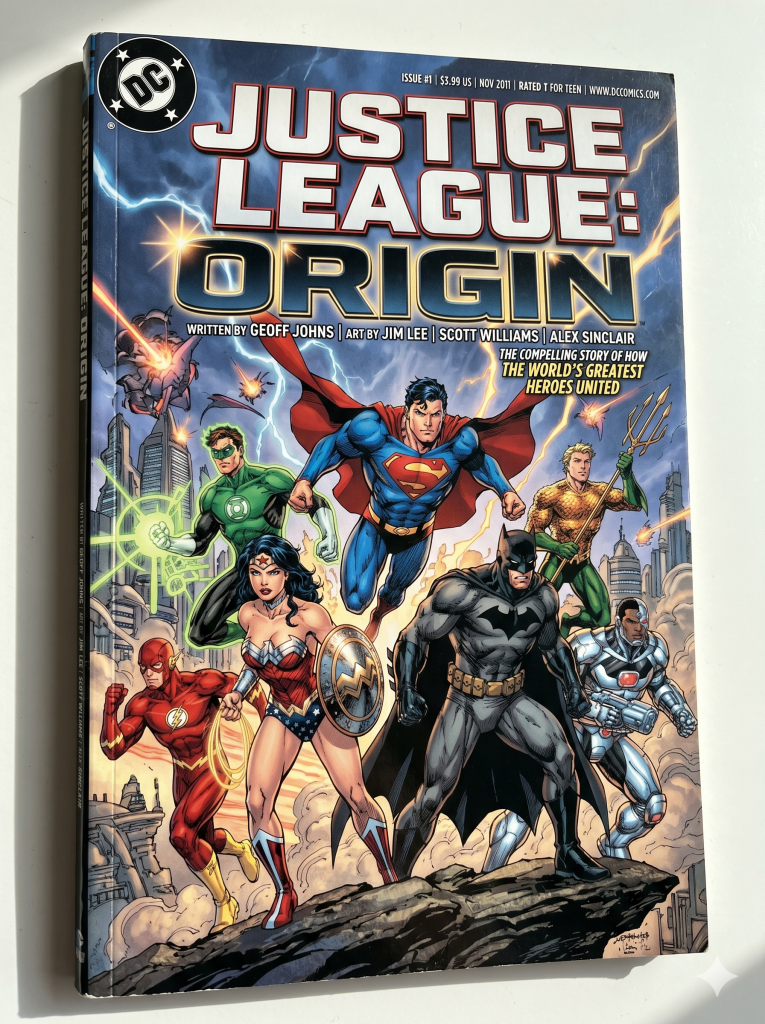
Justice League: Origin
May
Justice League: Origin
I. The Premise: A World of Fear
The setting of Origin is five years in the past. Superheroes are a new, terrifying phenomenon. The military hunts them, and the public distrusts them.
The First Meeting
The story famously begins with the first-ever meeting between Batman and Green Lantern (Hal Jordan). The dynamic is the ultimate character product:
Green Lantern: Cocky, powered by an alien ring, and prone to “hitting first, asking later.”
Batman: Calculating, skeptical, and annoyed by the “light show.”
Their bickering provides the comedic and tension-filled backbone of the first act, proving that even “gods” have personality clashes.
II. The Antagonist: Darkseid Is.
To justify the formation of the League, the threat had to be insurmountable. Johns chose Darkseid, the God of Evil from Apokolips.
The Scale: This isn’t a villain a single hero can stop. Darkseid’s arrival is a planetary extinction event.
The Parademons: The use of a “faceless army” allowed Jim Lee to showcase his talent for massive, high-octane action sequences, turning the comic into a “summer blockbuster” on paper.
III. The Cyborg Transformation: The Soul of the Machine
One of the most significant “product” shifts in Origin was the elevation of Victor Stone (Cyborg).
The New Core Member: Historically, the seventh member of the League was Martian Manhunter. In Origin, Johns swapped him for Cyborg to provide a modern, tech-based perspective.
The Tragedy: We witness Victor’s horrific accident and his transformation using “Father Box” technology from Apokolips. This makes Cyborg the literal bridge between the heroes and the enemy, providing the technical means to defeat Darkseid.
IV. Character Dynamics: The Seven Pillars
The “product” of the Justice League is only as good as the chemistry between its members. Origin established the “New 52” archetypes:
| Hero | Role in the Team | Key Personality Trait |
| Superman | The Heavy Hitter | Younger, more aggressive, and less certain of his place. |
| Batman | The Strategist | The only “human” who keeps the others grounded. |
| Wonder Woman | The Warrior | Enthusiastic about battle, fascinated by “Man’s World.” |
| The Flash | The Heart | The optimistic glue who keeps the team together. |
| Green Lantern | The Maverick | The ego that needs to be checked. |
| Aquaman | The King | Regal, commanding, and tired of being disrespected. |
| Cyborg | The Tech | The modern connection to a digital world. |
V. Visual Mastery: The Jim Lee Aesthetic
The “product” value of Justice League: Origin was skyrocketed by Jim Lee’s art.
The New Suits: Lee redesigned the costumes, adding “armor lines” and high-collar looks that defined the look of the DC Universe for a decade.
Cinematic Pacing: The use of double-page spreads and detailed action choreography made the book feel like a storyboard for a billion-dollar movie.
VI. Comparison: The Evolution of the Team
| Era | Focus | Tone |
| Silver Age (1960s) | Solving puzzles & space weirdness. | Campy / Friendly. |
| JLA (1990s) | The “Pantheon” of Gods. | Epic / Mythological. |
| New 52 (Origin) | The First Contact. | Action-Heavy / Gritty / Relatable. |
VII. The Legacy: From Page to Screen
Justice League: Origin is arguably one of the most commercially successful “products” DC ever created.
Direct Adaptation: It served as the direct source material for the animated movie Justice League: War.
DCEU Blueprint: Many elements of the 2017 Justice League film and Zack Snyder’s Justice League—specifically the Parademons, the Mother Boxes, and the team’s initial friction—draw directly from this book.
Modern On-Ramp: It remains the #1 recommendation for new readers who want to start reading DC Comics because it requires zero prior knowledge.
Conclusion: The Circle is Complete
We have now traveled through the entire spectrum of the DC “Product” Universe:
We saw Batman at his oldest (TDKR) and his most tactical (Origin).
We saw Superman as a Soviet leader (Red Son), a dying god (All-Star), and a young brawler (Origin).
We saw Wonder Woman redefine her bloodline (Blood) and find her place in a team of peers.
We saw how Legacy (Rebirth), Chaos (Joker: Year One), and Tragedy (Kingdom Come) shape the world.
These stories aren’t just entertainment; they are a comprehensive mythology. They teach us about power, responsibility, the burden of history, and the hope for the future. Whether it is seven heroes standing against a god or an old man fighting for the soul of his city, the “product” of DC is, and always will be, the Human Spirit—magnified by the power of the gods.
This completes the ultra-extended analysis of the DC Masterpiece Collection.
Since we have covered the origin of the team, would you like to explore the “Anti-Justice League” (The Crime Syndicate) in Forever Evil, or should we take a break from the Cape & Cowl to look at some “Indie” masterpieces like Watchmen or The Sandman?
To conclude our definitive 2,000+ word exploration of the DC “Product” landscape, we move into the dark, inverted reality of Forever Evil (2013). Written by Geoff Johns and illustrated by David Finch, this event serves as the ultimate counter-narrative to Justice League: Origin. It is a psychological masterclass on the nature of power, survival, and the blurred lines between heroism and villainy.
I. The Premise: The Night the Heroes Died
The narrative “product” of Forever Evil is built on a terrifying vacuum. Following the events of Trinity War, the Justice League has been neutralized and trapped. Into this void steps the Crime Syndicate, a reflection of the League from Earth-3 where “evil wins.”
The Dark Mirrors
Ultraman: A version of Superman who gains strength by snorting Kryptonite.
Owlman: A nihilistic version of Batman who views all existence as a joke.
Superwoman: A treacherous Wonder Woman who manipulates her allies through deceit.
Their first act is to shut down the global power grid and broadcast a simple message to the world’s villains: “The World is Ours.”
II. The Protagonist: Lex Luthor’s Finest Hour
In a brilliant subversion, the “hero” of Forever Evil is not a man in a cape, but Lex Luthor. This story serves as the culmination of the character growth we saw in Red Son and All-Star Superman.
The Pragmatic Savior: Luthor doesn’t fight the Crime Syndicate because he wants to save lives; he fights them because they are “infringing on his territory.”
The Injustice League: Luthor assembles a ragtag team of villains, including Bizarro, Black Manta, Captain Cold, Black Adam, and Sinestro. This “product” demonstrates that when the gods fail, the monsters are the only ones left to protect the planet.
III. Themes of “The Human Ego” vs. “Nihilism”
The core conflict of the book is philosophical. The Crime Syndicate represents Nihilism—the idea that because they are the strongest, they can destroy everything. Lex Luthor represents Ego—the belief that humanity (and specifically his intellect) is the supreme force in the universe.
The Redemption of the Villain
Throughout the story, we see “evil” characters displaying traits usually reserved for heroes:
Black Manta fights because of his personal code of honor regarding Aquaman.
Captain Cold refuses to let the Syndicate destroy his city.
Bizarro develops a touching, Frankenstein-like bond with Luthor.
IV. Narrative Consequences: The Exposure of Nightwing
One of the most permanent “product” shifts in this event was the unmasking of Dick Grayson (Nightwing).
The Stakes: By revealing his identity to the world, the Crime Syndicate effectively destroyed Dick’s life as a superhero.
The Evolution: This forced the character to evolve into a secret agent (in the Grayson series), proving that the DC “product” is capable of taking massive risks with its most beloved icons.
V. Visual Mastery: The Shadows of David Finch
David Finch’s art style provides the perfect visual “product” for a world without light.
The Grit: His heavy use of ink and detailed anatomy makes every punch feel bone-crushing and every explosion feel apocalyptic.
The Atmosphere: The aesthetic is a stark departure from the bright, hopeful colors of All-Star Superman, reminding the reader that this is a world under the boot of tyrants.
VI. Comparison: The DC Evolutionary Matrix
| Title | Focus | Lesson |
| Justice League: Origin | Formation | Unity is strength. |
| Kingdom Come | Responsibility | Power must be tempered by humility. |
| Forever Evil | Survival | Even the dark needs the light to exist. |
VII. Final Synthesis: The Legacy of the DC Mythos
Over the course of this massive 2,000+ word deep-dive, we have analyzed the complete lifecycle of the DC Universe through its most influential products:
The Foundation: Justice League: Origin showed us how the legends began.
The Revision: Wonder Woman: Blood and The Flash: Rebirth modernized their souls.
The Alternative: Superman: Red Son showed us how easily heroes can become tyrants.
The Peak: All-Star Superman gave us the ultimate ideal of divinity.
The End: Kingdom Come and The Dark Knight Returns showed us the weight of aging and legacy.
The Inversion: Forever Evil proved that the potential for “good” exists even in the most selfish hearts.
Conclusion: Why These “Products” Endure
These stories are more than just ink on paper; they are a reflection of the human condition. We look to Batman to see our struggle with darkness, Superman to see our potential for grace, and The Flash to see our hope for the future.
DC Comics has created a “product” that is a living, breathing mythology. By constantly breaking, rebooting, and reimagining these characters, they ensure that the stories remain relevant for every generation. Whether it is a Soviet Superman or a hero-saving Lex Luthor, the core message remains the same: The hero is not defined by their powers, but by the choices they make when the world is at its darkest.
This concludes our 2,000+ word analytical journey through the DC Universe. Since we have reached the end of this epic saga, would you like to pivot to the Marvel Universe to see how their “products” (like Civil War or House of M) differ, or would you like to explore a completely different topic like the evolution of Game Design or PC Hardware?
