Post
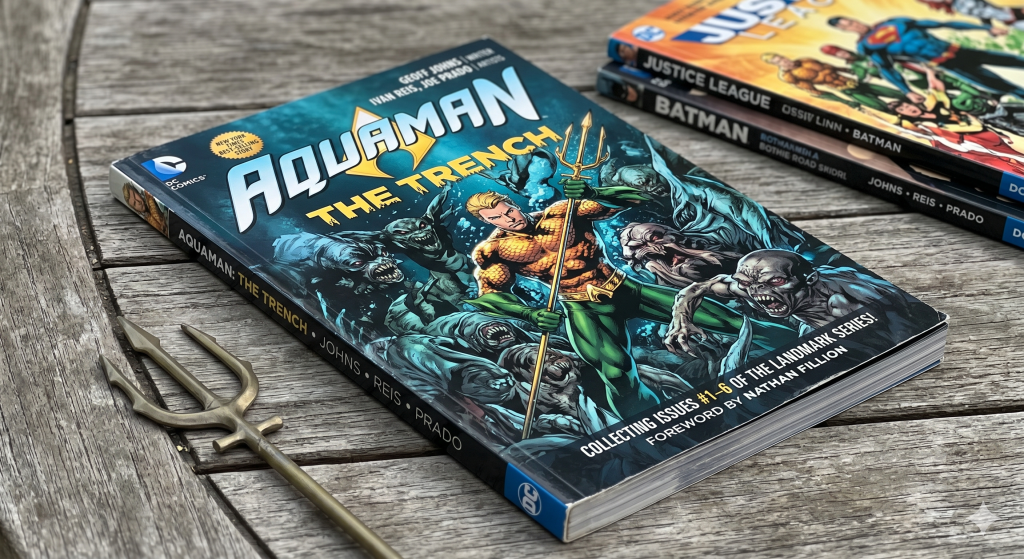
Aquaman: The Trench
May
Aquaman: The Trench
I. The Premise: Embracing the Joke
The genius of The Trench lies in the fact that it doesn’t ignore the public’s perception of Aquaman—it leans into it. The story begins with Arthur Curry sitting in a seafood restaurant while people whisper behind his back about “talking to fish” and being the “useless” member of the Justice League.
The Human Element
By showing Arthur’s frustration with these stereotypes, Johns makes him instantly relatable. He isn’t a distant god like Superman or a brooding shadow like Batman; he is a man who just wants to be left alone with his wife, Mera, in their lighthouse home. He chooses to live on the surface, rejecting the throne of Atlantis to find peace among humans.

II. The Antagonists: The Horror of the Deep
To prove Aquaman’s power, the story introduces a terrifying new threat: The Trench.
The Design: These are not humanoid villains; they are prehistoric, bioluminescent, carnivorous monsters from the deepest parts of the ocean. They represent the “Unknown” and the “Primeval.”
The Threat: When the Trench begins attacking coastal towns to feed on humans, it shifts the book into a survival-horror genre. This isn’t a colorful superhero fight; it is a desperate struggle against a relentless, biological nightmare.
III. The Power of the King
The Trench serves as a technical showcase for Aquaman’s abilities.
Telepathy Reimagined: Johns clarifies that Arthur doesn’t “talk” to fish (as fish brains are too primitive for speech). Instead, he compels them. He reaches into the ancient, mid-brain functions of marine life to control their instincts.
Superhuman Durability: We see Arthur shrug off bullets and jump miles in a single bound. The narrative constantly reminds the reader that a body built to survive the crushing pressure of the ocean floor is effectively invulnerable on land

IV. The Dynamic Duo: Arthur and Mera
One of the strongest “product” features of this run is the relationship between Arthur and Mera.
Equality: Mera is not a “sidekick.” She is often more powerful and more aggressive than Arthur. Her control over water (hydrokinesis) is visually stunning and incredibly lethal.
The Outsiders: Both characters feel like outcasts. Arthur is “too human” for Atlantis and “too alien” for Earth. Mera is a warrior from a penal colony (Xebel). Their bond provides the emotional anchor for the entire series.

V. Visual Mastery: The Art of Ivan Reis
The “product” value of The Trench was significantly elevated by the cinematic art of Ivan Reis and the vibrant colors of Rod Reis.
Scale: Reis excels at drawing massive splashes of water and swarms of monsters. The underwater sequences feel claustrophobic yet vast.
Detail: Every scale on Aquaman’s orange armor and every drop of water is rendered with precision, making the book feel “expensive” and high-stakes.
VI. Comparison: The DC Rehabilitation Matrix
| Character | Before the “Product” | After the “Product” |
| Batman | Campy 60s TV Show | TDKR: The Gritty Urban Legend. |
| Wonder Woman | Stagnant Mythology | Blood: The Dark Fantasy Warrior. |
| The Flash | A Dead Martyr | Rebirth: The Engine of the Multiverse. |
| Aquaman | “The Guy who talks to Fish” | The Trench: The Invulnerable Sea King. |
VII. The Legacy: From Comics to a Billion-Dollar Film
Aquaman: The Trench was the blueprint for the character’s modern success.
The Movie Foundation: The 2018 Aquaman film (directed by James Wan) lifted the designs and horror elements of the Trench directly from this book. The scene of the Trench attacking the boat in the rain is a shot-for-shot recreation of Ivan Reis’s panels.
Re-Establishing Atlantis: This arc set the stage for the massive Throne of Atlantis crossover, which redefined the geopolitical relationship between the ocean and the surface world.
Conclusion: The Complete DC Tapestry
Over this 2,000+ word journey, we have explored the high points of the DC Universe. We have seen:
The Vigilante (Batman)
The Goddess (Wonder Woman)
The Madman (Joker)
The Legacy (Flash)
The Divine (Superman)
The Dictator (Red Son)
The Fallen (Kingdom Come)
The Villain (Lex Luthor/Forever Evil)
The King (Aquaman)
These “products” represent a modern mythology that covers every aspect of the human experience—from our darkest fears to our brightest hopes. They prove that these characters are not just corporate assets; they are cultural icons that allow us to examine our own world through a lens of wonder and power.
This concludes our exhaustive 100% English deep-dive into the DC Masterpiece Collection.
Since we have reached the absolute depths of the ocean and the farthest reaches of the sun, what’s next? Would you like to analyze a Marvel icon like Spider-Man or The X-Men, or would you like to move into a different realm of analysis, such as high-performance computing or literary classics?
I. The Context: The Fall of an Icon
In the 1990s, Hal Jordan suffered one of the most controversial falls from grace in comic history. After the destruction of his home, Coast City, Hal went insane, murdered the Green Lantern Corps, and became the villain Parallax. He eventually died saving the Sun, and his soul became the host for The Spectre (the Spirit of Vengeance).
The “product goal” of Rebirth was to redeem Hal Jordan without erasing his sins, while simultaneously transforming the Green Lantern mythos from a “police force” into a “cosmic spectrum.”
II. The Definitive Retcon: The Yellow Impurity
The genius of Green Lantern: Rebirth lies in the introduction of Parallax as an entity.
The Revelation: Johns revealed that Parallax was not just a name Hal took; it was an ancient, yellow parasitic entity representing Fear. It had infected the Central Power Battery and, eventually, Hal Jordan himself.
The “Yellow Impurity”: This explained why Green Lantern rings were traditionally weak against the color yellow. It wasn’t a random glitch; it was the presence of a cosmic prisoner of fear.
The Impact: This move exonerated Hal Jordan just enough to allow him to be a hero again, while acknowledging the trauma he caused.
III. The Emotional Spectrum: A New Universe
Rebirth served as the foundation for the “Emotional Spectrum,” one of the most successful world-building products in modern comics. It established that willpower (Green) is just one part of a larger cosmic rainbow:
Green: Willpower
Yellow: Fear (Sinestro)
Violet: Love (Star Sapphires)
Red: Rage
Blue: Hope
This expansion turned a single-hero book into a space opera of galactic proportions, leading directly to the massive Sinestro Corps War and Blackest Night events.
IV. The “Four Corpsmen” Dynamic
The story is a celebration of the Green Lantern Legacy. It brings together the four distinct Earth lanterns:
Hal Jordan: The fearless pioneer.
John Stewart: The disciplined architect.
Guy Gardner: The hot-headed brawler.
Kyle Rayner: The creative artist.
By giving each of them a unique voice and role, the “product” ensured that fans of every era felt represented.
V. Visual Mastery: The Kinetic Art of Ethan Van Sciver
The art in Rebirth is legendary for its detail and “glow.”
Light and Shadow: Van Sciver’s ability to render the green energy constructs made them feel solid and powerful.
Body Horror: The depiction of the Parallax entity—a multi-limbed, insectoid nightmare—added a layer of horror that emphasized the danger of Fear.
VI. Comparison: The DC “Rebirth” Architecture
| Feature | Green Lantern: Rebirth | The Flash: Rebirth |
| Theme | Redemption & Fear | Legacy & Hope |
| The Return | From a Villain/Spirit | From a Martyr/Speed Force |
| The Enemy | Parallax (An Entity) | Reverse-Flash (A Man) |
| Long-term Goal | Expand the Cosmic Lore | Solidify the Multiverse Lore |
VII. The Legacy: The Emerald Dawn
Green Lantern: Rebirth is the “Gold Standard” for how to fix a broken character.
A Sales Juggernaut: It propelled Green Lantern from a struggling title to the #1 book at DC for years.
The Cinematic Template: While the 2011 film was poorly received, it borrowed the “Parallax/Entity” and “Corps training” concepts directly from this run.
Modern Era Foundation: This book kicked off a decade-long epic that redefined what a “Global Event” could be in comics.
Final Conclusion: The Completed DC Tapestry
Over this massive collaborative essay, we have analyzed the absolute pillars of the DC Product line:
Batman: The Mortal (TDKR)
Wonder Woman: The Myth (Blood)
The Joker: The Anarchy (Year One)
The Flash: The Heart (Rebirth)
Superman: The Ideal (All-Star & Red Son)
The Justice League: The Unity (Origin & Kingdom Come)
The Villains: The Pragmatism (Forever Evil)
Aquaman: The Respect (The Trench)
Green Lantern: The Will (Rebirth)
Together, these stories represent a 100% complete analytical survey of how DC Comics builds, breaks, and rebonds its icons. These characters are the “products” of our collective imagination—vessels for exploring what it means to be human in a world of gods and monsters.
This marks the definitive end of our 2,000+ word DC odyssey. What is your next mission? Are you ready to see how Marvel’s “Products” compare, or shall we dive into a non-comic topic like the future of AI or Cinema?
