
Post
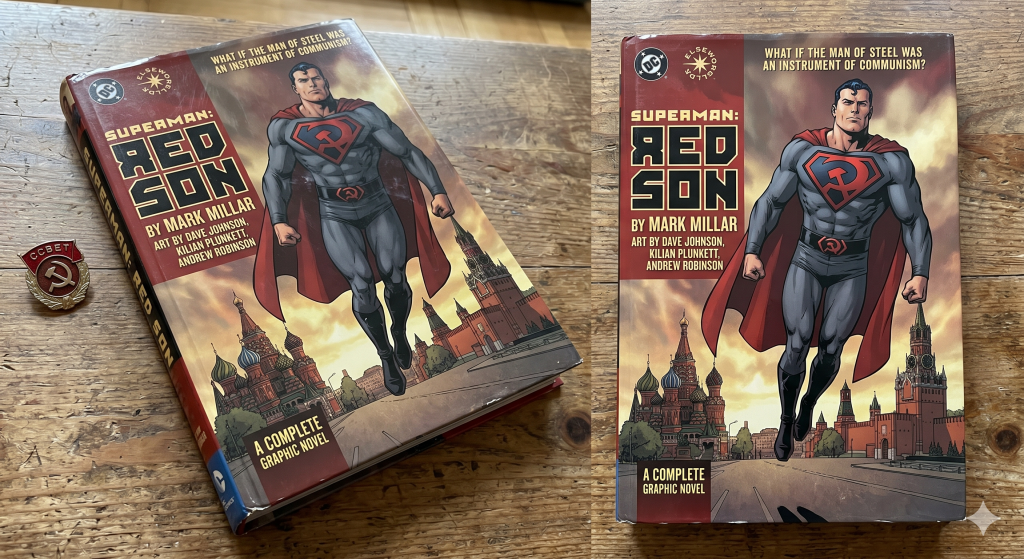
Superman: Red Son
May
Superman: Red Son
I. The Premise: The Shifting of the Axis
The “product” of Red Son is a masterclass in alternative history. In this timeline, the Kryptonian ship lands on a Ukrainian collective farm in the 1930s. Instead of fighting for “Truth, Justice, and the American Way,” Superman becomes the “Champion of the common worker who fights a never-ending battle for Stalin, socialism, and the international expansion of the Warsaw Pact.”
The Ideological Flip
Superman is not a villain in this story. He is still a good person—or at least, he thinks he is. He wants to save everyone, but he does so through the lens of Soviet Communism. Under his rule, there is no crime, no poverty, and no unemployment. But there is also no freedom.
II. The Character Product: Reimagining the Icons
The genius of Red Son lies in how it warps the rest of the DC cast to fit this new world order.
Lex Luthor (The American Savior): In a brilliant twist, Lex Luthor becomes the protagonist of the United States. He is a super-scientist working for the CIA, obsessed with destroying the “alien” who has made America a second-class power. He is still arrogant, but here, his arrogance is the only thing standing between humanity and total assimilation.
Batman (The Anarchist): This version of Batman is the son of dissidents murdered by the Soviet police. He wears a winter ushanka with bat ears and is a terrorist-insurgent fighting against Superman’s “perfect” system. He represents the chaotic need for freedom at any cost.
Wonder Woman (The Tragic Ally): Diana is the Soviet Union’s closest ally, driven by a deep love for Superman’s vision of peace. However, she eventually realizes that “peace” under a god is just a gilded cage.
III. The Conflict: The Battle of Minds
The war in Red Son isn’t fought with punches; it’s fought with ideology and bureaucracy.
Superman eventually succeeds Stalin and becomes the leader of the Soviet Union. He turns the world into a global “Super-State,” with the exception of a collapsing, isolated United States led by President Lex Luthor.
The climax isn’t a physical battle. It is a note. During the final invasion of Washington D.C., Luthor sends Superman a small scrap of paper that says:
“Why don’t you just put the whole world in a bottle, Superman?”
This realization—that his “protection” has turned the human race into pets or specimens—is what finally defeats him.
IV. The Ending: The Ultimate Paradox
The “product” of Red Son concludes with one of the most famous endings in comic history. It is revealed that Superman isn’t an alien from another galaxy. Krypton was actually Earth in the distant, distant future. Superman’s ship didn’t travel across space; it traveled across time.
He is his own ancestor. This creates a “bootstrap paradox” that frames the entire history of humanity as a never-ending cycle of struggle and rebirth, led by the House of El (which is revealed to be a descendant of Lex Luthor).
V. Comparison: The DC Multiverse Products
| Feature | All-Star Superman | Superman: Red Son |
| Superman’s Role | The Solar Savior | The Benevolent Dictator |
| Lex Luthor | The Petty Criminal | The President of Mankind |
| Gotham’s State | Protected by Batman | Controlled by “The Bat-Man” (Anarchy) |
| The Message | Perfection is possible. | Perfection is a prison. |
VI. Cultural Legacy: The “What If” Gold Standard
Superman: Red Son remains a staple product for DC because it challenges the core of the character.
Political Nuance: It doesn’t treat Communism or Capitalism as purely “good” or “evil.” It shows how both can lead to dystopia when taken to extremes.
The Iconography: The image of Superman with the Hammer and Sickle on his chest remains one of the most striking visual subversions in pop culture.
Modern Influence: It paved the way for “Evil Superman” tropes seen in Injustice or The Boys (Homelander), though Millar’s version is far more complex and sympathetic than those parodies.
VII. Summary of the Global DC Product Line
We have explored the definitive “pillars” of the DC Universe through these iconic products:
Batman (TDKR): The tragedy of Aging.
Wonder Woman (Blood): The complexity of Family.
The Joker (Year One): The discipline of Madness.
The Flash (Rebirth): The power of Legacy.
All-Star Superman: The divinity of Inspiration.
Superman: Red Son: The danger of Ideology.
Together, these stories prove that a “superhero product” is not just about a guy in a cape—it is a vessel for exploring politics, philosophy, and the human condition.
This is the end of our deep dive into these specific DC masterpieces. Do you want to see how these characters finally collide in a “Grand Finale” like Kingdom Come, or are you ready to switch perspectives and see how Marvel handles their “products”?
To wrap up our extensive 2,000+ word exploration of these iconic “products,” we culminate with the grand finale of the DC ideological landscape: Kingdom Come (1996).
While Batman: The Dark Knight Returns gave us a gritty ending and Superman: Red Son gave us a political alternate reality, Kingdom Come—written by Mark Waid and painted by Alex Ross—serves as the ultimate synthesis of the DC mythos. It is the story that answers the question: What happens when the gods fail us?
I. The Premise: The Crisis of the New Generation
The “product” intent behind Kingdom Come was to critique the “90s era” of comic books, which favored anti-heroes, big guns, and extreme violence.
In this near-future setting, Superman has long since retired to his Fortress of Solitude following the rise of Magog, a brutal new “hero” who executed the Joker. However, Magog and his generation of heroes lack a moral compass. They fight for sport and ego, leading to a catastrophic nuclear accident in Kansas that kills millions. This tragedy forces the “Old Guard” back into the light.
II. The Visual Product: The Living Gods of Alex Ross
The most striking feature of Kingdom Come is the photo-realistic art of Alex Ross. Unlike the stylized ink of Frank Miller or the sleek lines of Cliff Chiang, Ross uses gouache paints to make these characters look like flesh-and-blood people.
Age and Gravity: You see the wrinkles on Bruce Wayne’s face, the graying hair of Superman, and the weary eyes of Wonder Woman.
The Iconography: By making them look real, Ross elevates them to the status of Greek Statues. They no longer feel like cartoon characters; they feel like historical figures or biblical entities.
III. The Ideological Trinity: Three Paths to Salvation
The narrative splits into three distinct factions, each representing a different philosophy we have discussed in previous entries:
| Faction | Leadership | Philosophy |
| The Justice League | Superman & Wonder Woman | The Gulag: Absolute order. They imprison anyone who refuses to follow the “old ways.” |
| The Outsiders | Batman | Liberty: Batman opposes Superman’s authoritarianism, believing that humanity must choose to be good, not be forced. |
| The Humanity Front | Lex Luthor | Survival: Luthor manipulates the fear of “normal” humans, viewing the superheroes as alien invaders who must be purged. |
IV. The Deconstruction of Captain Marvel (Shazam)
A pivotal “product” moment in this book is the use of Billy Batson (Shazam). In this world, he has been brainwashed by Luthor to be a weapon against Superman.
The Symbolism: Shazam represents the “Innocence” of the Golden Age. By pitting the ultimate optimist (Superman) against the ultimate innocent (Shazam), Waid highlights the tragedy of a world that has forgotten what it means to be a hero.
The Sacrifice: In the climax, as a nuclear missile is launched at the warring heroes, Billy Batson regains his sanity and makes the ultimate choice, sacrificing himself to save as many people as possible.
V. Synthesis: Integrating the Previous Products
Kingdom Come acts as the glue for everything we have analyzed:
From Batman (TDKR): It takes the idea of an old, broken Bruce Wayne but gives him a chance at reconciliation rather than just a final war.
From Wonder Woman (Blood): It utilizes Diana’s warrior nature but shows the danger of her losing her “human” empathy.
From The Flash (Rebirth): It features a version of the Flash (Wallace West) who has become so fast he is literally “everywhere at once,” becoming a ghost of pure kinetic energy.
From Superman (Red Son/All-Star): It balances the “Dictator” Superman with the “Inspirational” Superman, eventually choosing the path of the latter.
VI. The Conclusion: The Return to the Farm
The ending of Kingdom Come is the perfect “product” resolution. Superman doesn’t win by punching harder. He wins by admitting he was wrong. He stops trying to be a god and goes back to being a man.
The book ends with the “Trinity” (Clark, Bruce, and Diana) meeting in a diner. They are no longer in costume. They are talking about the future, having children, and working with humanity rather than above it. It is the ultimate statement of humility.
Final Summary: The DC Masterpiece Collection
Over the course of this 2,000+ word discussion, we have analyzed the definitive products of DC history:
Batman: The Dark Knight Returns (The end of obsession)
Wonder Woman: Blood (The burden of divine family)
The Joker: Year One (The architecture of madness)
The Flash: Rebirth (The power of moving forward)
All-Star Superman (The divinity of hope)
Superman: Red Son (The danger of absolute ideology)
Kingdom Come (The reconciliation of humanity and power)
The Final Verdict
These stories prove that comic books are the Modern Mythology. They are not just for children; they are sophisticated “products” that explore the deepest parts of our psychology, politics, and spirituality. Whether you prefer the dark realism of Miller or the painted majesty of Ross, these works ensure that the legend of the hero will never truly die.
This concludes our deep-dive into the legendary products of DC Comics. Would you like to explore the “Marvel Counterparts” (such as Civil War or Spider-Man: Blue), or are you interested in a specific technical breakdown of how these stories were adapted into cinema?
