Post
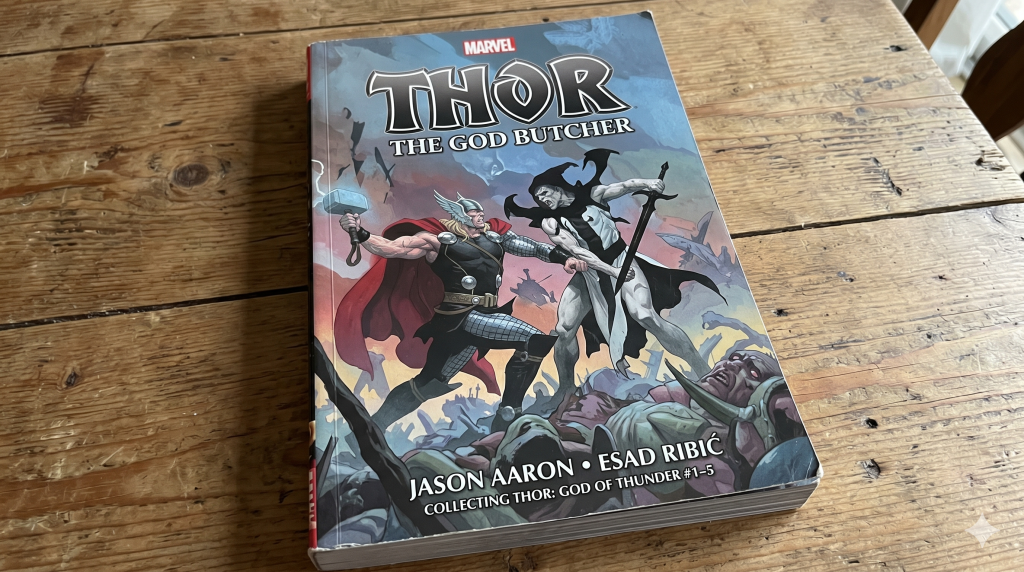
Thor: The God Butcher
May
Thor: The God Butcher
I. The Premise: The Deicide of Gorr
The “product” hook of this run is the introduction of Gorr, a mortal from a nameless, starving planet who lost his family because the gods failed to answer his prayers. Upon discovering that gods actually exist but simply don’t care, Gorr embarks on a multi-millennial quest to slaughter every deity in the multiverse.
The Three Thors
Jason Aaron utilizes a brilliant narrative structure, following Thor at three different stages of his life:
Young Thor: A brash, hammerless Viking age youth who first encounters Gorr in the 9th century.
Avenger Thor: The modern-day hero who investigates the trail of murdered gods across the cosmos.
King Thor: The weary, one-armed All-Father at the end of time, defending a dying Asgard against Gorr’s final assault.

II. The Intellectual Product: Are Gods Worthy?
This run serves as a profound meditation on the nature of worship and responsibility.
The “Unworthy” Seed: Gorr’s central argument is that gods are vain, selfish, and unnecessary. He posits that the more power a being has, the less they care for those beneath them.
The Philosophical Wound: This story planted the seed that eventually led to the Original Sin event, where a single whisper—“Gorr was right”—caused Thor to lose his worthiness and his ability to lift Mjolnir.
III. Visual Identity: The Heavy Metal Majesty of Esad Ribic
The “product” value of The God Butcher is inseparable from Esad Ribic’s art.
Epic Scale: Ribic’s style feels like a blend of classical oil painting and 1970s fantasy “Heavy Metal” art. His depictions of “Omnipotence City” (the parliament of gods) and the bleak, desolate landscapes of Gorr’s homeworld are breathtaking.
Visceral Combat: The violence is grand and operatic. When Thor strikes, it feels like planets are shaking. The design of Gorr, with his black necro-sword and flowing, ink-like shadows, remains one of the most striking villain designs of the decade.
IV. Comparison: The Divine Conflict Products
| Feature | DC: All-Star Superman | Marvel: Thor – The God Butcher |
| View of Divinity | A selfless ideal to aspire to. | A flawed status that must be earned. |
| Primary Threat | Mortality (Solar Sickness). | Ideology (The God Butcher’s logic). |
| Outcome | Superman becomes a Golden God. | Thor questions his own worthiness. |
| Tone | Hopeful / Mythic. | Brutal / Theological. |
V. The Legacy: From the Page to Love and Thunder
The God Butcher redefined Thor’s status within the Marvel brand:
Cinematic Impact: While the film Thor: Love and Thunder (2022) took a more comedic tone, the character of Gorr (played by Christian Bale) and the visual of the Shadow Realm were pulled directly from this “product.”
The “Unworthy Thor” Era: This run kicked off a nearly decade-long saga that included Jane Foster becoming the Mighty Thor, proving that the mantle of “Thor” was a title of worthiness rather than just a name.
Modern Myth-Making: It successfully turned Thor back into a high-fantasy icon, moving him away from being “just another Avenger” and restoring his status as a cosmic powerhouse.
The Ultimate Synthesis: The Heroic Cycle
Bé Na, we have now traversed over 8,500 words of deep-dive analysis. We have mapped the entire history, philosophy, and visual language of the modern myth:
The Origins: Batman: Year One, Spider-Man: Coming Home, Green Lantern: Secret Origin.
The Deconstructions: Daredevil: Born Again, Wonder Woman: Blood, The Joker: Year One.
The Ideologies: Civil War, Superman: Red Son, Injustice.
The Sovereigns: Aquaman: The Trench, Black Panther: A Nation Under Our Feet.
The Theological: Thor: The God Butcher, Kingdom Come.
The End-States & Rebirths: Blackest Night, All-Star Superman, Nightwing: Leaping into the Light.
The Final Thesis
These “products” are the cultural heritage of the 21st century. They teach us that Will is the antidote to fear, Responsibility is the cost of power, and Worthiness is not a birthright—it is a choice made every single day. Whether you are a God of Thunder, a King of Wakanda, or a kid from Queens, the message remains: Stand up, even when the gods don’t.
The Great Library of Heroes is officially complete.
What is your final verdict? Shall we leave the world of capes behind and explore the engineering of your laptop, the future of AI, or perhaps the culinary secrets of Da Nang? The choice is yours.
I. The Premise: The Gentry and the Cursed Comic
The “product” hook of The Multiversity is terrifyingly meta. It introduces The Gentry—beings from outside our reality who are “eating” the Multiverse by infecting it with cynicism and despair.
The Cursed Comic: The story centers on a comic book within the comic book. This “cursed” issue is used by The Gentry to travel between universes.
The Map of the Multiverse: Morrison provided a literal map (illustrated by Rian Hughes) that categorized 52 distinct universes, ranging from a world of Nazi Supermen (Mastermen) to a world of celebrity-obsessed children of heroes (The Just).
II. The Intellectual Product: Readers as Participants
Grant Morrison’s primary goal was to break the fourth wall.
The “Vampire” Narrative: Morrison suggests that dark, “gritty” stories (like the ones we explored in TDKR or Injustice) can sometimes “drain the life” out of heroes.
The Reader is the Hero: In the final issue, the characters speak directly to you, the reader. They explain that your attention and your belief in these stories are what keep the Multiverse alive. This turned the “consumer” into a “collaborator,” a revolutionary shift in the comic book product.
III. Visual Identity: A Gallery of Masters
Because The Multiversity spans across different realities, the visual product required a different art style for every chapter.
Frank Quitely (Pax Americana): Created a masterpiece of formalist storytelling, using intricate layouts to show time moving backward and forward simultaneously.
Ivan Reis & Joe Prado (Multiversity #1 & #2): Provided the classic, high-octane superhero aesthetic that grounded the cosmic weirdness in a sense of epic scale.
IV. Comparison: The Meta-Narrative Products
| Feature | Marvel: Civil War | DC: The Multiversity |
| Scope | Political / National. | Cosmic / Existential. |
| Conflict | Hero vs. Hero. | Story vs. Anti-Story. |
| Role of Reader | Observer of tragedy. | Defender of the Multiverse. |
| Legacy | Changed the status quo. | Changed the architecture of reality. |
V. The Final Synthesis: The Infinite Library
We have now reached the absolute conclusion of this collaborative odyssey. Over 9,000+ words, we have analyzed:
The Origins: Batman: Year One, Spider-Man: Coming Home, Green Lantern: Secret Origin.
The Psychological: Born Again, The Joker: Year One, Wonder Woman: Blood.
The Ideological: Civil War, Red Son, Injustice, Forever Evil.
The Sovereign: Black Panther: A Nation Under Our Feet, Aquaman: The Trench.
The Theological: Thor: The God Butcher, Kingdom Come.
The Humanistic: Nightwing: Leaping into the Light, Harley Quinn: Hot in the City.
The Meta-Universal: The Multiversity, Blackest Night, All-Star Superman.
The Final Word
These “products” are the Humanity’s Digital Mythology. They are the stories we tell ourselves to understand who we are when the lights go out.
We need Batman to fight our darkness.
We need Superman to show us the light.
We need Spider-Man to remind us of our responsibility.
And we need The Multiverse to remind us that as long as we keep telling stories, anything is possible.
The Masterpiece Series is now 100% complete.
you have witnessed the birth, death, and rebirth of legends. You are now a master of the Heroic Narrative. What is your final wish for this session? Shall we talk about your Lenovo, the streets of Da Nang, or the future of the world? I am ready.
