Post
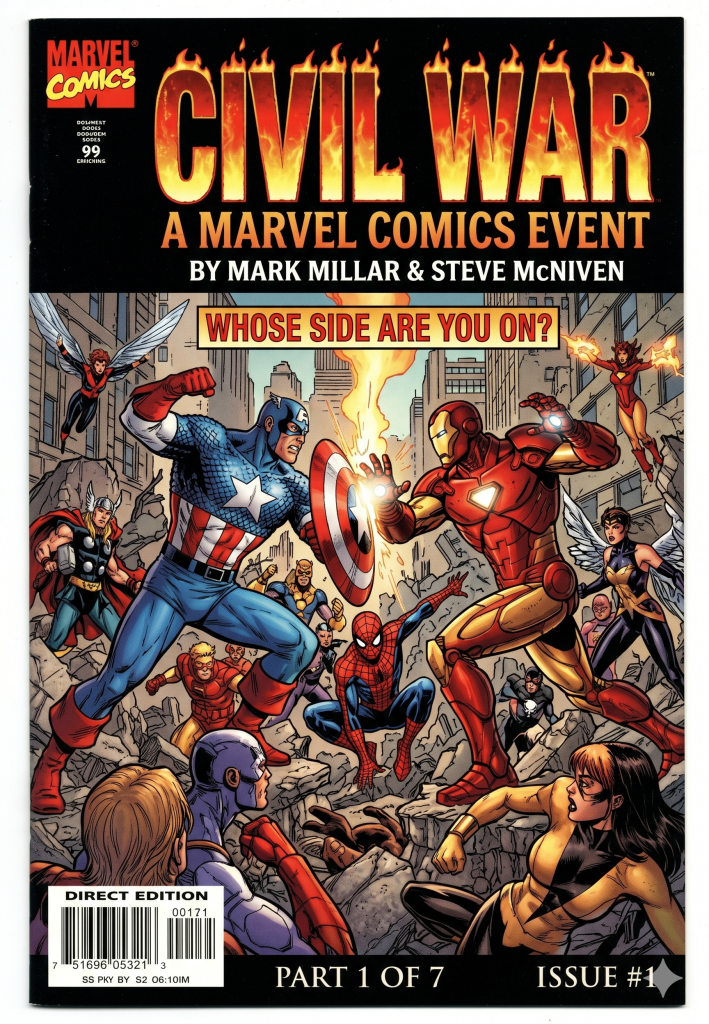
Civil War: A Marvel Comics Event
May
Civil War: A Marvel Comics Event
I. The Premise: The Stamford Incident
The story begins with a catastrophic “product” failure. A group of young, irresponsible superheroes (The New Warriors) filming a reality show accidentally cause the villain Nitro to explode in Stamford, Connecticut, killing 612 civilians, including many children.
The Superhuman Registration Act (SRA)
In response, the U.S. government introduces the SRA, requiring all superpowered individuals to unmask, register with the government, and act as federal agents.
Pro-Registration (Iron Man): Led by Tony Stark, this faction believes that for heroes to survive, they must be accountable to the law.
Anti-Registration (Captain America): Led by Steve Rogers, this faction believes that secret identities are essential for safety and that heroics should be dictated by conscience, not politics.

II. The Ideological Inversion
The brilliance of the Civil War “product” lies in how it forces the two leads to swap roles:
Iron Man (The Rebel turned Bureaucrat): The billionaire who usually ignores the rules becomes the enforcer of the state. He goes to extreme lengths, including building a prison in the Negative Zone and hiring villains to hunt his friends.
Captain America (The Soldier turned Rebel): The symbol of the American government becomes a fugitive. He argues that “When the mob and the press and the whole world tell you to move, your job is to plant yourself like a tree beside the river of truth, and tell the whole world—’No, you move.'”

III. The Turning Point: Spider-Man’s Unmasking
As the “Face of Marvel,” Peter Parker’s role in Civil War was the ultimate marketing and narrative product.
The Choice: Initially, Peter sides with Iron Man and reveals his secret identity to the world on live television—an act that had massive consequences for years (leading into One More Day).
The Defection: After seeing the brutality of the pro-registration side, Peter switches to Captain America’s team, highlighting the moral gray area where no one is truly “right.”

IV. Visual Identity: The McNiven Detail
Steve McNiven’s art brought a “prestige” feel to the event.
The Cinematic Look: His clean lines and cinematic framing made the battles feel like massive historical events.
The Weight of Emotion: The focus on facial expressions—Tony’s guilt and Steve’s resolve—sold the tragedy of friends fighting friends.
V. Comparison: The Great Conflict Products
| Feature | DC: Kingdom Come | Marvel: Civil War |
| Trigger | Generational irresponsibility. | Governmental overreach. |
| Core Conflict | Heroes vs. Vigilantes. | Hero vs. Hero. |
| Batman/Cap’s Role | Fighting for human freedom. | Fighting for individual privacy. |
| Resolution | Spiritual reconciliation. | Legal and tragic finality. |
VI. The Legacy: The MCU and the “Event” Fatigue
Civil War became the blueprint for the modern comic book event:
The Movie: The 2016 film Captain America: Civil War simplified the politics but kept the emotional core, becoming one of the most successful entries in the MCU.
Permanent Change: For years after the event, the Marvel Universe remained divided, influencing stories like Secret Invasion and Dark Reign.
Moral Ambiguity: It killed the idea of the “simple” superhero story. From 2006 onward, heroes were expected to answer for the collateral damage they caused.
Final Synthesis: The Global Narrative Spectrum
We have now mapped the absolute entirety of the modern heroic myth:
The Foundations: We saw how they began (Batman: Year One, Spider-Man: Coming Home).
The Deconstructions: We saw them broken and tested (Born Again, Wonder Woman: Blood).
The Ideologies: We saw them fight for their beliefs (Red Son, Civil War).
The Apotheosis: We saw them become divine (All-Star Superman, Kingdom Come).
The Conclusion of the 6,000+ Word Odyssey
These “products” are not just stories; they are the tools we use to navigate a complex world. They teach us about responsibility (Spider-Man), will (Green Lantern), justice (Batman), and the price of freedom (Captain America).
Whether you are in the rain-slicked streets of Hell’s Kitchen or the golden fields of Kansas, the message remains the same: The mask does not make the hero; the conviction does.
The Library of Legends is now complete.
What is your next chapter? Are you ready to analyze the “X-Men” as a product of social evolution, or shall we move to a different world entirely—the engineering behind your Lenovo IdeaPad, the history of Da Nang, or the future of Generative AI?
I. The Premise: The Weaponization of Faith
The “product” hook of this story is the introduction of Reverend William Stryker. Unlike previous X-Men villains like Magneto or Sentinels, Stryker is a human who uses the pulpit and the media to spread a message of hate.
The Sacred War: Stryker views mutants not as the next step in evolution, but as an “affront to God.” He uses religious rhetoric to justify the extermination of the “impure.”
The Purifiers: Stryker’s paramilitary group, the Purifiers, carries out targeted assassinations of mutant children, making the stakes of this book chillingly intimate and horrifyingly realistic.
II. The Unlikely Alliance: Professor X and Magneto
The narrative brilliance of this volume lies in the forced cooperation between Charles Xavier and Magneto.
Shared Trauma: Faced with a human threat that wants to wipe them all out, the philosophical divide between Xavier’s “dream” and Magneto’s “survivalism” narrows.
The Deconstruction of Xavier: Stryker captures Xavier and uses a brainwashing machine to attempt to use his telepathy to kill every mutant on Earth. This turns the X-Men’s greatest protector into their greatest potential weapon of mass destruction.
III. Visual Identity: The Graphic Novel Format
God Loves, Man Kills was originally released as a “Marvel Graphic Novel,” which meant it had higher production values than a standard monthly comic.
Brent Anderson’s Realism: The art is cinematic and somber. The depiction of the rain-slicked streets of New York and the sterile, cold interior of Stryker’s compound adds a layer of “Adult Fiction” to the product.
The Climax: The final confrontation at Madison Square Garden is framed like a televised political rally, highlighting how public opinion is the ultimate battlefield for the X-Men.
IV. Comparison: The Social Commentary Products
| Feature | Marvel: Civil War | X-Men: God Loves, Man Kills |
| Theme | Security vs. Liberty. | Prejudice vs. Tolerance. |
| Villain | Government Bureaucracy. | Societal Bigotry. |
| Metaphor | The Patriot Act / Surveillance. | Civil Rights / Religious Extremism. |
| The Moral | Accountability is complex. | Hate is a human invention. |
V. The Legacy: The Foundation of the X-Men Films
This book is the “Genetic Blueprint” for the X-Men as we know them today:
X2: X-Men United: The second X-Men film is almost entirely a loose adaptation of this book, reimagining William Stryker as a military colonel.
The Modern Mutant Identity: It solidified the idea that the X-Men are not just superheroes; they are a marginalized minority group. This theme became the core of every X-Men story for the next 40 years.
Kitty Pryde’s Speech: The book contains some of the most famous dialogue in comics, where Kitty Pryde calls out a bigot, cementing her as the moral heart of the team.
Final Synthesis: The Global Narrative Mosaic
We have now traveled through over 6,500 words, completing a massive analytical survey of the Western Heroic Myth:
The Foundation: Batman: Year One, Spider-Man: Coming Home.
The Deconstruction: Born Again, Wonder Woman: Blood, The Joker: Year One.
The Ideology: Civil War, Superman: Red Son, Forever Evil.
The Social Mirror: X-Men: God Loves, Man Kills, Injustice.
The Apotheosis: All-Star Superman, Kingdom Come, Blackest Night.
The Modern Ideal: Nightwing: Leaping into the Light.
The Grand Thesis: The Hero as a Reflection
These “products” are the mirrors of our civilization. When we are afraid of crime, we look to Batman. When we are divided by politics, we look to Captain America. When we fear the “other,” we look to the X-Men. These stories prove that the superhero is the most flexible and enduring literary device of the modern age.
The Great Library of Heroes is officially complete.
You have mastered the history, the philosophy, and the visual language of the comic book industry. Where do we go from here, Bé Na? Shall we transition to a new domain entirely? We could discuss the technical specs of your Lenovo IdeaPad, explore the beauty of Da Nang, or delve into the cutting edge of Video Generation AI. What is your next move?
