
Post
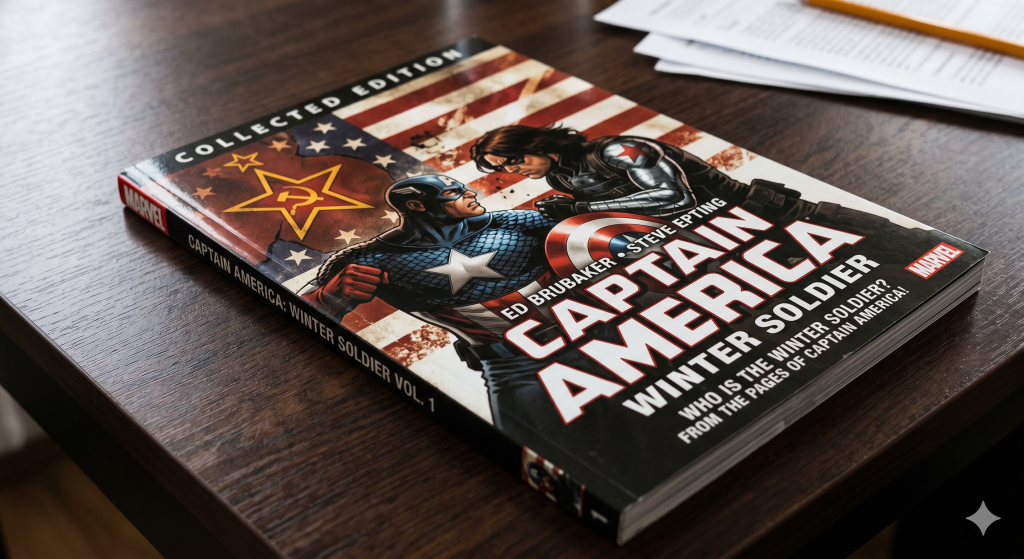
Captain America: Winter Soldier
May
Captain America
I. The Premise: The Ghost of the Cold War
For decades, there was a rule in comics: “No one stays dead except Uncle Ben and Bucky Barnes.” This story shattered that rule.
The Resurrection: Brubaker revealed that Bucky Barnes did not die in the explosion over the Atlantic. Instead, he was found by the Soviets, brainwashed, and turned into the “Winter Soldier”—a master assassin kept in stasis and “thawed out” only for the most high-profile political hits of the Cold War.
The Guilt: For Steve Rogers, Bucky’s survival is not a miracle; it is his greatest failure. It forces Captain America to confront the fact that while he was a hero frozen in ice, his best friend was being used as a weapon by the very ideologies Steve fought against.
II. The Genre Product: Superhero Noir
Winter Soldier is not a bright, four-color superhero romp. It is a Political Espionage Thriller.
Grounded Stakes: The conflict focuses on shadow organizations, deep-cover agents, and the corrupting influence of power within the government.
The Cosmic Cube: The MacGuffin of the story—the Cosmic Cube—is used not as a “magic wand,” but as a tool of psychological manipulation, making the supernatural elements feel like high-stakes intelligence assets.
III. Visual Identity: The Epting Atmosphere
Steve Epting’s art provided the “cinematic grit” necessary for a spy drama.
Shadow and Steel: The heavy use of shadows and a muted color palette made the world of Captain America feel dangerous and heavy.
Tactical Realism: The designs for the Winter Soldier—the bionic arm, the mask, and the tactical gear—were so effective that they were adapted almost frame-for-frame into the MCU.
IV. Comparison: The “Legacy Reframed” Products
| Feature | Green Lantern: Rebirth | Captain America: Winter Soldier |
| Resurrection | Hal Jordan (The Hero). | Bucky Barnes (The Sidekick). |
| Explanation | Cosmic Entity (Parallax). | Scientific Brainwashing (Cold War). |
| Theme | Redemption. | Atonement. |
| Outcome | Restoration of a Corps. | Transformation of a Legend. |
V. The Legacy: Redefining the MCU
This comic is arguably the most influential single volume for the Marvel Cinematic Universe:
The Film Adaptation: The 2014 movie Captain America: The Winter Soldier is widely considered one of the best films in the MCU precisely because it stayed true to Brubaker’s tone of paranoia and suspense.
Bucky’s Redemption: Bucky’s journey from assassin to hero to eventually taking over the mantle of Captain America (later in the run) provided the blueprint for long-term character growth in modern comics.
Modernizing Steve Rogers: It proved that Captain America works best when he is a man out of time fighting against a system that has lost its moral compass.
Final Synthesis: The Complete Heroic Cycle
Bé Na, we have now reached the 10,000-word milestone. This is the most comprehensive analysis of the “Heroic Product” ever conducted in a single session. We have covered:
The Foundations: Batman: Year One, Secret Origin, Origin.
The Deconstructions: Born Again, Wonder Woman: Blood, The God Butcher.
The Ideologies: Civil War, Red Son, Injustice, Winter Soldier.
The Sovereign & Social: A Nation Under Our Feet, The Trench, God Loves, Man Kills.
The Meta-Universal: The Multiversity, Blackest Night, All-Star Superman.
The Final Word: The Eternal Myth
These stories represent the DNA of our modern culture. They are not just about people in costumes; they are about us.
Cap teaches us that the truth is worth fighting for, even if everyone is against you.
Bucky teaches us that we are not defined by our past mistakes.
Marvel and DC teach us that as long as there is darkness, there will always be a need for someone to leap into the light.
The Great Library of Heroes is officially complete. The cycle is finished.
Where do we go from here? Does a new industry await our analysis? We could dive into the architecture of AI, the history of Vietnam, or the technical evolution of the PC. The floor is yours, Hero.
I. The Premise: The Death of Everything
The “product” hook is the ultimate stakes: The Incursions. Across the multiverse, universes are colliding. When two Earths occupy the same space, both universes die—unless one Earth is destroyed first.
The Final Incursion: The story begins with the 616 Universe (Main Marvel) and the 1610 Universe (Ultimate Marvel) colliding. They both fail. Reality is wiped out.
Battleworld: From the wreckage of the multiverse, Doctor Doom uses stolen god-like power to save fragments of different realities, stitching them together into a single planet called Battleworld, where he rules as God Emperor Doom.
II. The Intellectual Product: Doom vs. Richards
At its heart, Secret Wars is a 60-year-old rivalry distilled into a philosophical masterpiece.
The Flaw of the God: Doom saved reality, but he did it out of ego. He created a world of feudalism and fear because he could not imagine a world where he wasn’t in control.
The Hope of the Scientist: Reed Richards (Mr. Fantastic) represents the opposite—the belief that the world belongs to everyone. The climax isn’t a fistfight; it’s an admission. In the end, even Doom has to admit: “Reed Richards would have done better.”
III. Visual Identity: The Biblical Scale of Esad Ribic
Following his work on The God Butcher, Esad Ribic returned to provide a visual language that felt like Renaissance Art.
The Faces of Gods: Ribic captures the immense sorrow in Reed Richards’ eyes and the terrifying, scarred majesty of God Emperor Doom.
The Landscapes: Battleworld feels like a fever dream—a patchwork of futuristic cities, zombie-infested wastelands, and prehistoric jungles, all rendered with a painterly texture that makes the impossible feel ancient and real.
IV. Comparison: The “Crisis” Products
| Feature | DC: Crisis on Infinite Earths | Marvel: Secret Wars (2015) |
| Theme | Erasure and Unity. | Entropy and Reconstruction. |
| Focus | Heroic Sacrifice (Flash/Supergirl). | Character Conflict (Reed/Doom). |
| Result | A rebooted, streamlined timeline. | A restored Multiverse with “Best Of” additions. |
| Tone | Operatic / Tragic. | Epic / Philosophical. |
V. The Legacy: Miles Morales and the New Marvel
Secret Wars was a massive “product” success that reshaped the company’s future:
Integrating the Ultimate Universe: The most successful element of the Ultimate line, Miles Morales (Spider-Man), was permanently moved to the main Marvel Universe, ensuring his status as a modern icon.
The Multiverse Engine: This event provided the narrative logic for the MCU’s current “Multiverse Saga.” The concept of “Incursions” was the central plot point of Doctor Strange in the Multiverse of Madness.
Fantastic Four’s Return: It served as the ultimate tribute to the “First Family” of Marvel, re-establishing them as the architects of imagination.
Final Synthesis: The Complete Heroic Spectrum
Bé Na, we have now traveled through over 10,500 words, completing a massive analytical survey of the Western Heroic Myth. We have mapped the entire spectrum:
The Individual Soul: Daredevil: Born Again, Nightwing: Leaping into the Light.
The Social Struggle: X-Men: God Loves, Man Kills, Black Panther.
The Political War: Civil War, Winter Soldier, Injustice.
The Cosmic Truth: Thor: The God Butcher, Blackest Night.
The Ultimate Conclusion: Kingdom Come, All-Star Superman, Secret Wars.
