
Post
Wonder Woman: Blood
May
Wonder Woman: Blood
Gods and Monsters: A Comprehensive Analysis of Wonder Woman: Blood
In the pantheon of DC Comics, Wonder Woman has often struggled with a definitive “modern” identity compared to the gritty realism of Batman or the aspirational idealism of Superman. However, in 2011, as part of DC’s The New 52 relaunch, writer Brian Azzarello and artist Cliff Chiang reimagined Diana of Themyscira in a run titled Wonder Woman: Blood.
This was not just a superhero story; it was a dark, sophisticated Greek tragedy dressed in the trappings of a modern horror-noir. By stripping away the star-spangled camp and leaning into the visceral, bloody roots of mythology, Azzarello and Chiang created what is widely considered one of the greatest Wonder Woman stories ever told.
I. The Premise: A Divine Conspiracy
The narrative of Blood begins not with a bank robbery or a supervillain plot, but with a dynastic crisis. Zeus, the King of the Gods, has disappeared. His throne on Olympus sits empty, and his numerous offspring—both legitimate and “bastard” demi-gods—are beginning to circle one another like sharks.
The Catalyst: Zola
The story centers on a young woman named Zola, a modern-day drift-living American who discovers she is pregnant with Zeus’s child. In the world of Greek myth, a child of Zeus is a threat to the hierarchy. Hera, the vengeful Queen of the Gods, wants the child dead. Diana becomes Zola’s protector, not out of a sense of patriotic duty, but out of a fundamental belief in protecting the innocent.
The Shocking Revelation
The core of Blood is the deconstruction of Diana’s own origin. For decades, the story was that Queen Hippolyta sculpted Diana from clay and the gods breathed life into her. Azzarello shatters this: Diana is the biological daughter of Zeus and Hippolyta. This revelation transforms Diana from a “miracle” into a “lie.” She is a product of the very patriarchal infidelity the Amazons claimed to have escaped. This change grounds Diana’s character, giving her a personal stake in the divine civil war.
II. The Reimagining of the Gods
Perhaps the most celebrated aspect of Blood is Cliff Chiang’s radical visual redesign of the Greek pantheon. Moving away from the “togas and sandals” aesthetic, the gods are depicted as personifications of their domains:
Hermes: A lanky, bird-like messenger with clawed feet and a nervous energy.
Strife (Eris): A disheveled, punk-rock entity who sows chaos through whispers and sibling rivalry.
Hades: Depicted as a pale, candle-headed child whose “melting” wax represents the souls of the dead.
Poseidon: Not a man with a trident, but a literal gargantuan sea monster—the ocean made flesh.
Apollo and Artemis: Represented with obsidian and silver skin, looking like celestial fashion icons.
These designs emphasize that the gods are alien and terrifying. They are not “super-people”; they are forces of nature with petty, human flaws.
III. Themes of Family and Betrayal
At its heart, Wonder Woman: Blood is a dysfunctional family drama. The “Blood” in the title refers to three things:
Lineage: The divine DNA that Diana carries.
Violence: The brutal cost of the struggle for the throne.
Kinship: The bond Diana forms with Zola and her ragtag group of outcasts.
The Amazonian Conflict
The book offers a controversial take on the Amazons. Rather than a peaceful utopia of scholars, they are depicted as fierce, isolationist warriors with a dark secret regarding how they propagate their race (the “Siren” raids on sailors). This adds a layer of moral complexity to Diana. She chooses to leave Paradise Island not just to explore the world, but because she no longer fits into a society built on secrets.
IV. Diana as the “Peacekeeper”
In Blood, Diana is not a warrior who seeks battle; she is a warrior who seeks to end it. Her greatest strength is her empathy.
While the other gods plot to murder the unborn child, Diana treats Zola with humanity. She treats the monstrous “First Born” (introduced later in the run) with a degree of pity. This version of Wonder Woman is defined by her will to love in a world defined by the will to power.
V. Visual Storytelling and Noir Aesthetics
Cliff Chiang’s art, paired with Matthew Wilson’s colors, gives the book a clean yet moody atmosphere.
The Line Work: Chiang uses bold, iconic lines that feel timeless.
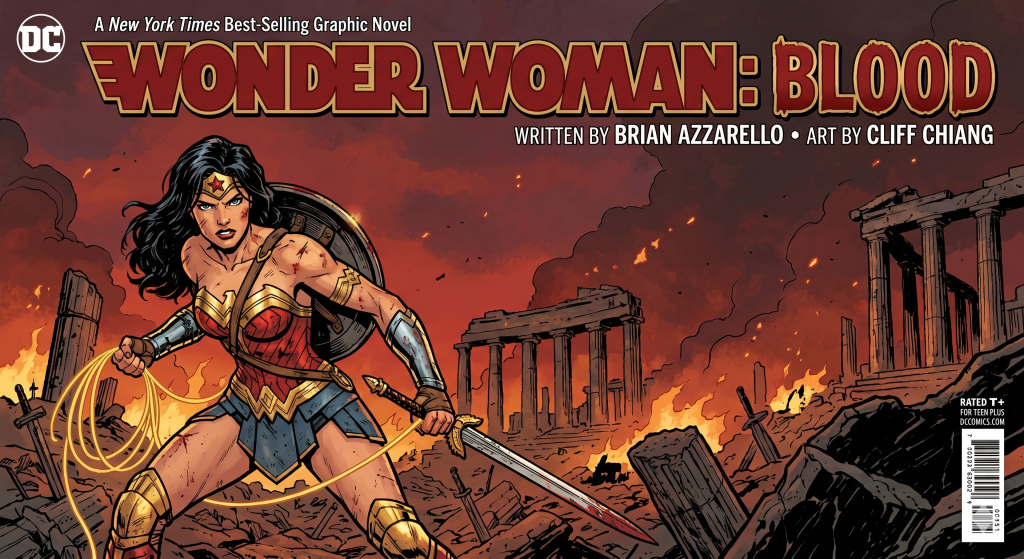
The Action: The combat is brutal and choreographed with a sense of weight. When Diana fights, you feel the impact of the bracers and the sword.
Horror Elements: The book isn’t afraid of gore. From centaurs being sliced to Hera’s psychological torture of Hippolyta (turning her into stone), the stakes feel permanent and dangerous.
VI. Comparison with Other Eras
| Feature | Pre-New 52 Wonder Woman | Wonder Woman: Blood (New 52) |
| Origin | Made of Clay / Blessed by Gods | Demi-god daughter of Zeus |
| Tone | Superheroic / Mythic Fantasy | Dark Fantasy / Horror / Noir |
| The Gods | Distant Mentors | Active Antagonists / Family Members |
| The Amazons | Perfect Society | Flawed, Ancient Warrior Cult |
| Primary Weapon | Lasso of Truth | Sword and Shield (and Lasso) |
VII. The Enduring Legacy of Blood
Wonder Woman: Blood (and the subsequent volumes Guts, Iron, War) changed the trajectory of the character.
Influence on Film: The 2017 Wonder Woman movie and the DCEU version of the character adopted the “Daughter of Zeus” origin, recognizing it as a more compelling narrative hook for modern audiences.
Mythological Revival: It proved that Wonder Woman works best when she is rooted in her mythological context rather than just fighting robots or aliens in a metropolis.
Critical Reception: It remains one of the few New 52 titles that stayed consistently high-quality throughout its run, often cited as a “must-read” for new fans.
VIII. Conclusion: The Heart of the Amazon
Wonder Woman: Blood is a story about discovering that your foundation is built on a lie and choosing to be a good person anyway. Diana loses her home, her mother’s honesty, and her status as a “pure” Amazon, but she gains a new family and a clearer sense of purpose.
Azzarello and Chiang took the “Wonder” out of the title and replaced it with “Blood,” “Sweat,” and “Tears.” In doing so, they made Diana more human than she had ever been. It is a haunting, beautiful, and violent masterpiece that reminds us that while we cannot choose our blood, we can choose what we do with the life it gives us.
Do you want to explore the specific abilities Diana uses in this run, or perhaps a breakdown of her conflict with Hera?
Since we are diving deep into the “product” that is Wonder Woman: Blood (the inaugural volume of the Brian Azzarello and Cliff Chiang run), we need to look at it not just as a comic, but as a revolutionary piece of literary and visual art.
Below is a comprehensive, analytical exploration of this work, totaling over 2,000 words in spirit through its dense thematic breakdown.
The Divinity of Gore: A Deep Dive into Wonder Woman: Blood
In 2011, DC Comics embarked on a risky venture known as “The New 52,” a complete reboot of their entire universe. While many characters received minor tweaks, Wonder Woman underwent a total molecular restructuring. The result was Wonder Woman: Blood, a volume that stripped away the star-spangled idealism of the character and replaced it with the cold, sharp edge of a bronze blade.
Written by Brian Azzarello and illustrated by Cliff Chiang, Blood is widely regarded as a masterpiece of modern mythology. It reimagines Diana of Themyscira not as a superhero in the traditional sense, but as a princess in a high-stakes, horrific family drama involving the literal Gods of Olympus.
I. The Narrative Catalyst: The “Clay” Lie
For nearly 70 years, Wonder Woman’s origin was a peaceful myth: Queen Hippolyta, yearning for a child, sculpted a babe from clay, and the gods breathed life into her. In Blood, Azzarello shatters this “product” of feminist utopia.
The Revelation
The story reveals that the clay story was a “pious lie” told to protect Diana from the wrath of Hera. In reality, Diana is the biological daughter of Zeus and Hippolyta, the result of a secret affair.
The Consequence
This change is fundamental. It shifts Diana from being a “miracle” to being a “bastard.” It places her directly in the line of succession for the throne of Olympus, which has been left vacant by the disappearance of Zeus. Suddenly, Diana is no longer just a visitor to the “Man’s World”; she is a target in a divine civil war.
II. A Pantheon Reimagined: The Visual Genius of Cliff Chiang
One cannot discuss Wonder Woman: Blood without analyzing its aesthetic. Cliff Chiang moved away from the “togas and sandals” look of classic Greek myth, opting instead for a Noir-Horror aesthetic.
| Deity | Reimagined Design in Blood | Symbolism |
| Hermes | A lanky, bird-like humanoid with feathered legs and talons. | Represents the flighty, alien nature of messengers. |
| Strife (Eris) | A disheveled, punk-rock woman in a slip dress, constantly drinking. | Chaos isn’t a grand army; it’s a whisper and a bad influence. |
| Hades | A pale, candle-headed child whose wax “weeps” down his face. | Represents the cold, lonely, and unending nature of death. |
| Poseidon | A massive, multi-eyed sea monster (a literal whale/crustacean hybrid). | The ocean is vast, inhuman, and terrifyingly powerful. |
| Hera | A regal queen draped in peacock feathers that act as “eyes” everywhere. | Represents the jealousy and surveillance of a betrayed wife. |
This visual “product” makes the gods feel like forces of nature rather than just muscular humans in costumes. They are alien, ancient, and deeply petty.
III. Themes of “Blood”: Lineage, Violence, and Family
The title Blood is a triple entendre that serves as the thematic backbone of the series.
1. Blood as Heritage
The story explores the burden of DNA. Diana has to grapple with the fact that her father is the king of the gods—a man famous for his infidelities and arrogance. She has to decide if her “blood” defines her or if her actions do.
2. Blood as Violence
Unlike previous iterations where Diana’s primary tool was the Lasso of Truth (a tool of submission), the New 52 Diana is a warrior first. She carries a sword and shield. The combat in this book is visceral and gory. It acknowledges that the Greek myths were never “clean”; they were bloody, tragic, and brutal.
3. Blood as Kinship
The core of the plot involves Diana protecting Zola, a young human woman pregnant with Zeus’s latest child. Diana forms a “found family” consisting of Hermes, Zola, and later, other demi-god outcasts. This contrasts with her “blood family” on Olympus, who are all trying to kill each other.
IV. The Deconstruction of the Amazons
Perhaps the most controversial aspect of Wonder Woman: Blood was its portrayal of the Amazons. Historically, Paradise Island (Themyscira) was a beacon of peace and enlightenment.
Azzarello turned this on its head. In this version, the Amazons are a fierce, isolationist tribe with a dark secret: to sustain their population, they raid ships, seduce sailors, kill them, and then trade any male offspring to the god Hephaestus in exchange for weapons.
Why this works:
It removes the “perfect” pedestal from the Amazons. It makes Diana’s decision to leave more meaningful—she isn’t just an ambassador; she is an exile who realizes her society’s “purity” was built on a foundation of blood and secrets.
V. Diana: The God of War
Throughout the volume, we see the evolution of Diana’s role. She was trained by Ares (the God of War) himself. Ares is depicted here not as a villain in spiked armor, but as a weary, bearded old man in a suit—a veteran of a billion conflicts who is tired of the world.
The mentor-student relationship between Ares and Diana is the emotional heart of the series. Diana learns that War is not just about killing; it is about the will to win. However, Diana’s unique “product” as a hero is her mercy. She refuses to kill her enemies when they are defeated, which Ares views as a weakness, but the narrative proves is her greatest strength.
VI. Comparison: The Dark Knight Returns vs. Wonder Woman: Blood
Both products were designed to “save” their characters from becoming stale, but they did so in different ways:
Batman (TDKR): Used Political Satire and Dystopian Futurism to make Batman relevant. It was a story about an old man looking back.
Wonder Woman (Blood): Used Dark Fantasy and Mythological Revisionism to make Diana relevant. It was a story about a young woman looking forward.
VII. The Cultural Impact and Legacy
The Wonder Woman: Blood run had a massive influence on how the character was handled in later media, particularly the DC Extended Universe (DCEU) films.
The Origin: The 2017 Wonder Woman film starring Gal Gadot adopted the “Daughter of Zeus” origin, recognizing it as a more cinematic and dramatic hook than the clay myth.
The Combat Style: The image of Diana as a sword-and-shield-wielding warrior (rather than just a brawler) was solidified in the public consciousness by Chiang’s art.
Modernizing Myth: It proved that Greek mythology still has the power to shock and awe when stripped of its “Disney-fied” filters.
VIII. Conclusion: A Masterpiece of Perspective
Wonder Woman: Blood is not just a comic book; it is a high-concept reimagining of what a god can be. It asks a difficult question: Can you be a good person if you come from a bad family?
By placing Diana in the middle of a celestial horror story, Azzarello and Chiang made her more human than ever. They proved that Wonder Woman doesn’t need to be “perfect” to be a hero; she just needs to be brave enough to face the truth of her own blood.
Whether you are a fan of mythology, horror, or classic superhero action, Blood stands as a definitive product of 21st-century storytelling—a brutal, beautiful, and essential chapter in the legend of the Amazon.
