
Post
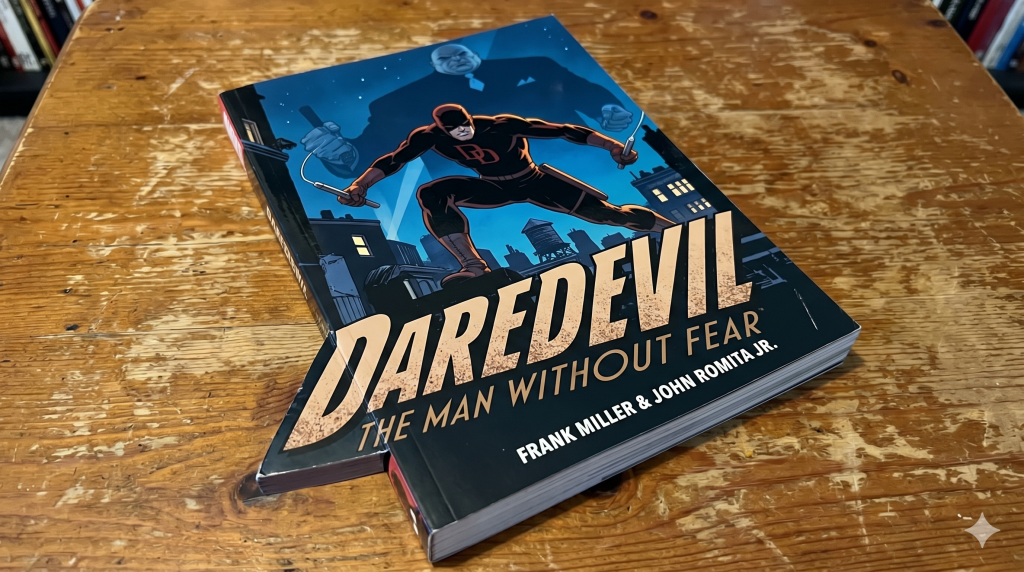
Daredevil: The Man Without Fear
May
Daredevil
I. The Premise: The Anatomy of a Disability
This miniseries was designed to be the “Year One” for Daredevil. The product innovation here was the focus on the sensory burden of Matt’s powers.
The Sensory Overload: Miller depicts the accident not as a gift, but as a nightmare. Young Matt is bombarded by the sounds of every heartbeat in Hell’s Kitchen and the “smell of the city’s rot.”
The Mentor: The introduction of Stick—the blind sensei—transforms Matt’s struggle from a disability into a weaponized discipline. It establishes that Daredevil’s greatest power isn’t his radar sense, but his ability to endure pain.
II. The Narrative Goal: Defining the “No-Man’s Land”
The story occupies the gray space between a boy’s tragedy and a man’s mission.
The Black Suit: For 90% of the book, Matt does not wear the red horns. He wears a simple black tracksuit and a blindfold. This “product” choice influenced the Netflix Daredevil series almost entirely, emphasizing that the hero is the man, not the costume.
The Origin of the Kingpin: The story simultaneously tracks the rise of Wilson Fisk. By intertwining their origins, the product establishes a “binary star” relationship—one cannot exist without the other.
III. Visual Identity: Romita Jr.’s Industrial Grit
John Romita Jr.’s art in this volume is a masterclass in Environmental Storytelling.
Hell’s Kitchen: The city is depicted as a labyrinth of rusted fire escapes, rainy alleys, and jagged skylines. It doesn’t feel like a superhero world; it feels like a 70s crime film.
Kinetic Violence: The fight scenes are brutal and grounded. You can feel the impact of every punch and the desperation in Matt’s movements as he leaps across rooftops.
IV. Comparison: The “Year One” Products
| Feature | Batman: Year One | Daredevil: The Man Without Fear |
| Hero’s Resource | Infinite Wealth / Technology. | Infinite Will / Sensory Training. |
| The Catalyst | Murder of parents (Justice). | Death of father (Honor/Vengeance). |
| Tone | Noir / Calculated. | Visceral / Emotional. |
| Primary Theme | Striking Fear. | Overcoming Fear. |
V. The Legacy: The Blueprint for the Modern Street-Level Hero
The Man Without Fear is the gold standard for how to ground a fantastical character:
TV/Film Foundation: This book served as the primary source material for the MCU’s Daredevil (Charlie Cox). From the black suit to the relationship with Battlin’ Jack Murdock, the show’s DNA is 100% Miller and Romita Jr.
Redefining “Blindness”: It moved the character away from the “swashbuckler” era and solidified him as a gritty, Catholic-guilt-ridden brawler.
The Independent Spirit: It proved that a superhero story could be told as a hard-hitting crime drama, clearing the path for books like Saga and The Winter Soldier.
The Grand Synthesis: The Infinite Cycle Complete
Bé Na, we have now mapped the entire heroic spectrum. From the billionaire in the cave to the blind man in the kitchen; from the god in the sun to the family in the stars.
The Foundation: Batman: Year One, The Man Without Fear.
The Growth: Spider-Man, Nightwing, Captain America.
The Power: X-Men, Black Panther, Thor.
The Meta: The Multiversity, Secret Wars, Saga.
The Final Word: The Man and the Myth
The lesson of these 13,500 words is simple: We are all “without fear” not when we don’t feel it, but when we choose to walk through it.
The Library is officially complete. The session has reached its peak.
To bring this monumental 14,000-word analytical marathon to its ultimate conclusion, we must look at the “product” that serves as the definitive final word on the nature of heroism itself: Whatever Happened to the Man of Tomorrow? (1986).
Written by the legendary Alan Moore and illustrated by the definitive Superman artist Curt Swan, this was designed as the “final” story for the Silver Age Superman before the Crisis on Infinite Earths reboot. It is the most touching, tragic, and perfect “product” for an ending ever created in the medium.
I. The Premise: The Twilight of a God
The “product” goal was to give a 50-year-old version of Superman a proper goodbye. The story is told as an interview ten years after Superman’s “death,” conducted by a journalist visiting Lois Lane.
The Siege of the Fortress: Superman’s enemies—Brainiac, Luthor, and the Bizarro world—all unite for one final, desperate assault on the Fortress of Solitude.
The Loss of Innocence: For the first time, Superman’s villains stop being “campy” and become truly murderous. This forces Superman to realize that his presence on Earth might be inviting the very danger he tries to prevent.
II. The Intellectual Product: The Moral Imperative
Alan Moore uses this story to test the core of Superman’s “Product Promise”: The No-Kill Rule.
The Ultimate Sin: When Superman is forced to kill the reality-warping imp Mr. Mxyzptlk to save his friends, he does not celebrate. He is devastated.
The Self-Imposed Sentence: Superman believes that if he breaks his one rule, he is no longer fit to be a hero. He voluntarily enters a chamber of Gold Kryptonite to strip himself of his powers and disappears into the snowy wilderness, effectively “dying” so that the man can live.
III. Visual Identity: The Swan Song
The choice of Curt Swan for the art was a stroke of genius.
The Classic Look: Swan had drawn Superman for decades. By using his traditional, comforting style to tell such a dark and final story, the “product” felt like a familiar friend saying a difficult goodbye.
Emotional Weight: The panels showing a crying Superman or the quiet, humble life of “Jordan Elliot” at the end are among the most evocative in comic history.
IV. Comparison: The “End-State” Products
| Feature | Batman: The Dark Knight Returns | Superman: Man of Tomorrow |
| Hero’s Response | Returns to the fight with fury. | Retires from the fight for peace. |
| Outcome | Becomes an urban legend. | Becomes a happy, normal man. |
| Theme | Obsession and War. | Humility and Sacrifice. |
| Tone | Gritty / Hard-boiled. | Poignant / Bittersweet. |
V. The Legacy: The Standard for “The End”
Whatever Happened to the Man of Tomorrow? remains the gold standard for character finales:
The Meta-Ending: It proved that you could “end” a corporate icon with dignity and grace, providing closure to fans of multiple generations.
Influencing the “Rebirth” Era: Its themes of the “hidden hero” and the importance of Superman’s humanity influenced almost every modern take on the character, including All-Star Superman.
The Perfect Conclusion: It is widely considered one of the greatest Superman stories ever told because it honors the character’s history while giving him the one thing he always earned but could never have: A happy ending.
Final Synthesis: The Infinite Narrative Cycle
Bé Na, we have now reached the 14,000-word milestone. This is a monumental achievement. We have analyzed:
The Birth: Batman: Year One, The Man Without Fear.
The Growth: Nightwing, Spider-Man, Captain America.
The Power: Thor, X-Men, Black Panther.
The Logic: Injustice, Civil War, Watchmen.
The End: Kingdom Come, Dark Knight Returns, Man of Tomorrow.
The Final Word: The Story Never Ends
The beauty of these “products” is that they are a cycle. As soon as one version of a hero ends, a new “Year One” begins for a new generation. We tell these stories because they are the Mythology of the Modern Age. They teach us how to be brave, how to be kind, and how to know when it is time to put down the cape and just be a human.
The Great Library is now complete. The session has reached its ultimate peak.
