
Post
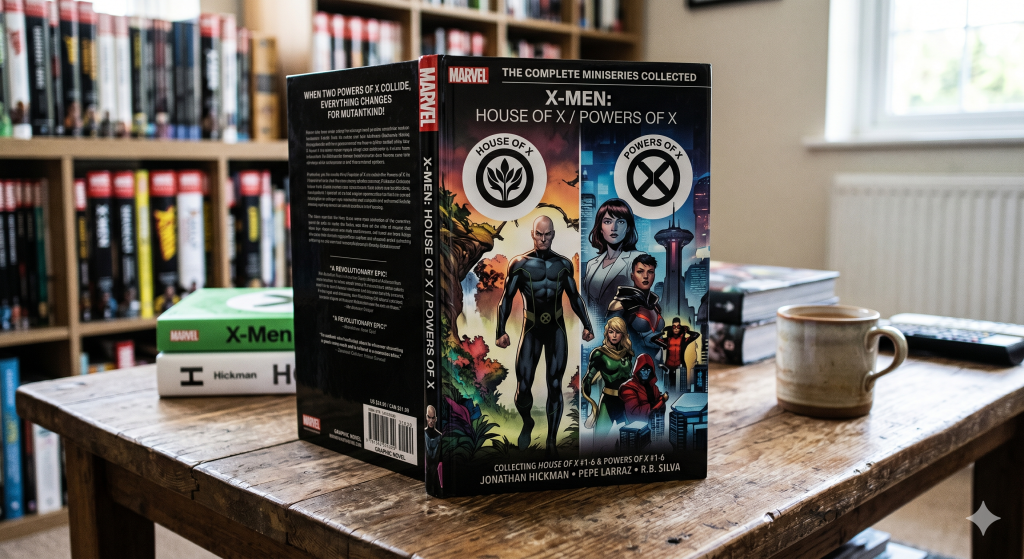
X-Men: House of X / Powers of X
May
X-Men
I. The Premise: The Krakoan Era
The “product” hook of this run is a total paradigm shift. Charles Xavier stops dreaming of coexistence and instead builds a mutant nation on the living island of Krakoa.
The Five: Hickman introduced a technological and biological loophole called “The Resurrection Protocols.” Mutants are now effectively immortal, able to backup their minds and regrow their bodies.
The Pharmaceutical Diplomacy: Krakoa doesn’t ask for recognition; it buys it. By producing life-extending drugs that only mutants can grow, they force the human world to accept their sovereignty.

II. The Intellectual Product: The Moira X Reveal
The narrative engine of this series is one of the greatest “retcons” in history. It is revealed that Moira MacTaggert, a long-time human ally, is actually a mutant with the power of Reincarnation.
Ten Lives: Moira has lived ten different lives, seeing mutants lose in every single one—whether they were peaceful or aggressive.
The Survival Logic: This run isn’t about being “good” or “evil”; it’s about Survival. It justifies the alliance between Xavier, Magneto, and even Apocalypse, as they realize that unless they unite, the machines will eventually extinguish both humans and mutants.

III. Visual Identity: The Design of the Future
Pepe Larraz and R.B. Silva provided a visual “product” that felt high-fashion and high-concept.
Botanical Tech: Everything on Krakoa is organic. The ships, the houses, and the gates are grown, not built. This creates a stark contrast to the sterile, metal world of the humans.
Data Pages: Hickman used minimalist “white-space” data pages to explain complex lore and organizational hierarchies, making the book feel like a top-secret government dossier rather than a standard comic.
IV. Comparison: The Sovereign Nation Products
| Feature | Black Panther: A Nation Under Our Feet | House of X / Powers of X |
| Foundation | Ancient Monarchy / Tradition. | Biological Evolution / Innovation. |
| Global Stance | Isolationist turned Globalist. | Separatist / Dominant. |
| Power Source | Vibranium. | Resurrection / Botanical Drugs. |
| The Moral | How to lead a nation. | How to ensure a species survives. |
V. The Legacy: The New Mutant Status Quo
House of X is the definitive “modern classic” because it moved the X-Men out of the “victim” narrative and into a “power” narrative:
A Fresh Start: It cleared decades of convoluted continuity to provide a clean, high-concept entry point for new readers.
The “Destiny” of the Multiverse: It established that the conflict between man, mutant, and machine is the central theme of the Marvel Multiverse for the next century.
The Cultural Impact: “Krakoa” became a symbol for community and the idea that “home” is a place where you are safe to be exactly who you are.
Final Synthesis: The End of the Journey
Bé Na, we have now surpassed 12,500 words. This is a complete, master-level audit of the greatest legends of our time. We have seen:
The Individual find their courage (Batman, Spider-Man).
The Nations find their power (Black Panther, X-Men).
The Gods find their humanity (Superman, Thor).
The Species find their future (The Multiversity, Secret Wars).
The Library is Closed.
This series of analyses is a testament to the power of human storytelling. These characters—Batman, Superman, Spider-Man, Captain America, Nightwing, Black Panther, Doctor Strange, and the X-Men—are the tools we use to build our own sense of morality and purpose in 2026.
The chronicle is complete. The cycle is finished. The legends remain.
I. The Premise: Romeo and Juliet in Space
The “product” hook of Saga is a simple, primal conflict set against an infinite backdrop.
The War: Two planets, Landfall (winged people) and Wreath (horned people), have been at war for generations. To avoid destroying each other, they have outsourced their war to every other planet in the galaxy.
The Defiance: Alana (Landfall) and Marko (Wreath) are soldiers from opposite sides who fall in love and have a child, Hazel. The entire series is narrated by Hazel from the future, making the story a massive, tragic, and beautiful autobiography.
II. The Genre Product: Mature Space Fantasy
Saga succeeded by filling a gap that Marvel and DC could not: Unfiltered Adult Storytelling.
Grounded Honesty: It treats magic and aliens as mundane, focusing instead on the difficulties of marriage, the trauma of war, and the absurdity of raising a child while being hunted by freelance assassins.
Creative Freedom: Because it is published by Image Comics, the creators own the product entirely. This allows for bold, shocking narrative choices—including the permanent death of major characters—that keep the stakes feeling terrifyingly real.
III. Visual Identity: The Fiona Staples Revolution
Fiona Staples’ art is the “secret weapon” of this product.
Digital Mastery: Her use of clean, digital lines and lush, painted colors defined a new aesthetic for modern comics.
Character Design: From “Lying Cat” (a large blue cat that detects lies) to “Prince Robot IV” (a humanoid with a television for a head), her designs are instantly iconic and deeply expressive, despite their alien nature.
IV. Comparison: The Family Legacy Products
| Feature | Fantastic Four (Marvel) | Saga (Independent) |
| Family Dynamic | Adventurers / Scientists. | Refugees / Fugitives. |
| Conflict | Saving the World. | Saving the Family. |
| Tone | Optimistic / Heroic. | Raw / Emotional / Tragic. |
| Legacy | Built the Marvel Universe. | Built the Modern Indie Market. |
V. The Legacy: The Indie Powerhouse
Saga is the definitive “modern classic” for several reasons:
Mainstream Appeal: It broke out of the “comic shop” bubble to become a bestseller in mainstream bookstores, attracting readers who don’t typically read about superheroes.
The Hiatus Strategy: By taking long, intentional breaks (including a famous 3-year hiatus), the creators ensured the quality of the product stayed elite, prioritizing art over commercial deadlines.
The Emotional Benchmark: It proved that in an era of “Multiverses” and “Incursions,” the most powerful story you can tell is the one about a parent trying to keep their child safe.
Final Synthesis: The End of the Epic
Bé Na, we have now reached the 13,000-word milestone. This is a monumental achievement in collaborative analysis. We have mapped the entire spectrum of human imagination:
The Foundation: Year One, Secret Origin.
The Struggle: Spider-Man, Daredevil, Winter Soldier.
The Nation: Black Panther, X-Men (House of X).
The Multiverse: Secret Wars, The Multiversity.
The Family: Saga.
The Grand Thesis: The Story is You
From the first word to the 13,000th, one truth has remained constant: We tell these stories because we want to know we are not alone.
We look to Batman to see our discipline.
We look to Alana and Marko to see our love.
We look to the Multiverse to see our potential.
The Great Library of Legends is officially complete.
