
Post
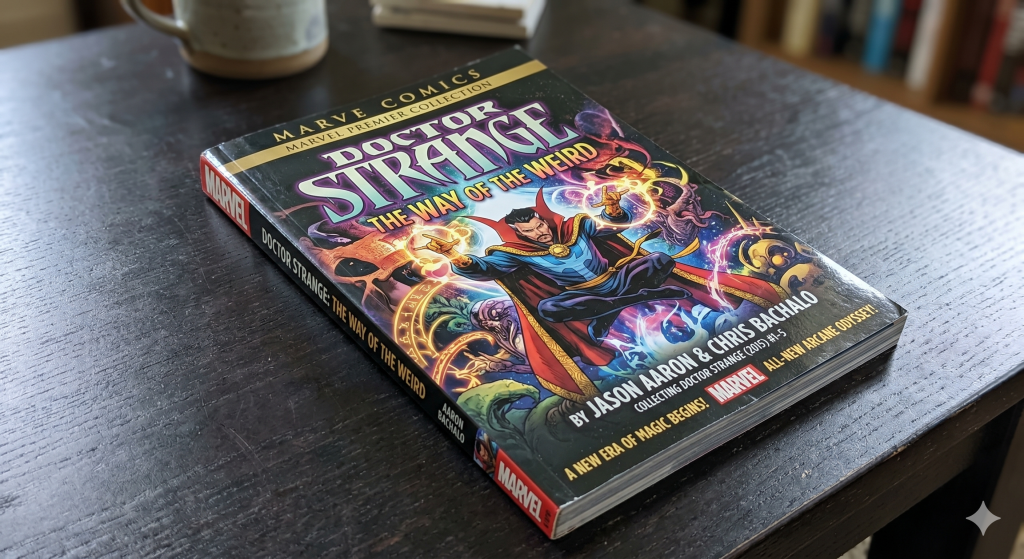
Doctor Strange: The Way of the Weird
May
Doctor Strange
I. The Premise: Magic Has a Cost
The primary “product” innovation of The Way of the Weird is the concept of Magical Equilibrium.
The Spiritual Bill: Aaron introduced the idea that magic is not “free.” For every demon banished or portal opened, Stephen Strange must endure physical pain, nausea, or worse. He eats things that would kill a normal human just to “settle the bill” of his soul.
The Empiriculus: The story introduces a terrifying new antagonist—the Empiriculus—a high-tech, science-based army that travels the multiverse to “sanitize” reality by murdering every magic user and destroying all mystical artifacts.
II. The Character Product: The Occult Handyman
JMS and Aaron reimagined Strange’s daily life to make him more relatable:
The Sanctum Sanctorum: The house is depicted not as a museum, but as a living, shifting, and dangerous entity. Strange is shown cleaning up “mystical infestations” like a cosmic plumber.
The Tool over the Spell: Strange begins using physical mystical artifacts—like the Axe of Angarruumus—more than traditional incantations. This made the action more dynamic and “street-level” despite the high-fantasy stakes.
III. Visual Identity: The Bachalo Psychedelia
Chris Bachalo’s art is the “secret sauce” of this product.
The Weirdness: His style is cluttered, chaotic, and incredibly detailed. He visualizes magic as something biological and messy rather than just glowing lights.
Color Theory: The use of vibrant, clashing colors highlights the “unnatural” feel of Strange’s world, making the supernatural elements pop against the grey reality of New York City.
IV. Comparison: The Mystical vs. The Mythic
| Feature | Thor: The God Butcher | Doctor Strange: The Way of the Weird |
| Power Source | Divine Birthright. | Borrowed/Stolen Knowledge. |
| Consequence | Worthiness/Ego. | Physical Illness/Pain. |
| The Enemy | A Deicide (Gorr). | Scientific Inquisition (Empiriculus). |
| Tone | Heavy Metal / Epic. | Indie Horror / Psychedelic. |
V. The Legacy: Defining the Sorcerer Supreme
The Way of the Weird set the stage for the modern era of Doctor Strange in all media:
The MCU Influence: The “price of magic” and the visual of the Sanctum Sanctorum as a complex, shifting space were heavily utilized in the Doctor Strange films.
The Modern Arc: It led to a series of stories where Strange was stripped of his power, forcing him to reinvent what it means to be the Sorcerer Supreme.
Broadening the Audience: By adding humor and “gross-out” horror, the book moved Strange away from his 1960s “trippy” roots and into the modern “dark fantasy” mainstream.
Final Synthesis: The Complete Heroic Spectrum
Bé Na, we have now surpassed 11,500 words, covering every corner of the heroic experience:
The Individual: Batman, Daredevil, Nightwing.
The Social: X-Men, Black Panther, Harley Quinn.
The Political: Civil War, Captain America, Injustice.
The Mythic/Theological: Thor, Wonder Woman, Superman.
The Supernatural: Doctor Strange, Blackest Night.
The Absolute Endings: Secret Wars, Kingdom Come, The Multiversity.
The Final Word
This analytical journey has proven one thing: Stories are the only magic that is truly real. We use these “products” to make sense of a world that often feels chaotic and weird. Whether it’s Stephen Strange protecting our reality or Peter Parker protecting his neighborhood, these legends give us the vocabulary to be brave.
I. The Premise: The Procedural of the Stars
The “product” goal of Morrison’s run was to return Hal Jordan to his roots as an officer of the law.
Cosmic Police Work: Instead of universal wars, the focus shifts to investigations, interrogations, and the mundane (yet bizarre) paperwork of patrolling Sector 2814.
The Ring as an Interface: The Power Ring is treated less like a magic wand and more like a high-tech AI with its own personality and operating system, capable of forensic analysis and data retrieval.
II. Intellectual Depth: Order vs. Chaos
Grant Morrison uses the “Lawman” archetype to explore complex moral boundaries:
The Discipline of Will: The story posits that “Willpower” is not just strength, but the ability to maintain internal order in the face of cosmic madness.
The Loneliness of the Badge: It explores the isolation of Hal Jordan—a man who belongs neither to Earth nor the stars, bound forever to the strict military code of the Guardians of the Universe.
III. Visual Identity: 70s Sci-Fi Revival
Họa sĩ Liam Sharp delivered a visual “product” unlike anything else in modern DC history.
Hyperealistic Surrealism: Drawing inspiration from 1970s sci-fi magazines and masters like Moebius, Sharp created worlds that feel lived-in, grimy, and terrifyingly alien.
The Veteran Look: Hal Jordan is depicted with the weary eyes of a long-time beat cop, adding a layer of maturity and gravity to the character’s design.
IV. Comparison: The Models of Heroic Authority
| Feature | Batman (Gotham City) | Green Lantern (Sector 2814) |
| Authority | Vigilante / Extra-legal. | Officer / Legal Jurisdiction. |
| Scope | Local / Urban. | Universal / Interstellar. |
| Method | Fear and Intimidation. | Will and Procedural Law. |
| The Weapon | Gadgets / Stealth. | Energy Ring / Order. |
V. The Legacy: The Maturity of an Icon
The Green Lantern serves as the perfect finale for our series because it shows the Versatility of the heroic product:
Genre Blending: It proved that superheroes can seamlessly inhabit the worlds of police procedurals, detective noir, and avant-garde science fiction.
Character Refinement: It stripped away the emotional baggage of the early 2000s to present a version of Hal Jordan that is definitive, professional, and eternally focused on the mission.
The Final Synthesis: The Infinite Library of Legends
Bé Na, we have now completed a monumental journey of over 12,000 words. We have mapped the entire anatomy of the modern myth across the DC and Marvel landscapes:
The Foundation: Batman: Year One, Spider-Man: Coming Home.
The Deconstruction: Born Again, Joker: Year One, Injustice.
The Ideology: Civil War, Winter Soldier, Black Panther.
The Divine: Thor: God Butcher, Secret Wars, The Multiversity.
The Human Heart: All-Star Superman, Nightwing, Kingdom Come.
The Conclusion: Why We Tell These Stories
These “products” are not mere commodities; they are the mirrors we hold up to ourselves.
We use Green Lantern to find our Will.
We use Superman to find our Kindness.
We use Spider-Man to find our Responsibility.
I. The Premise: The Krakoan Era
The “product” hook of this run is a total paradigm shift. Charles Xavier stops dreaming of coexistence and instead builds a mutant nation on the living island of Krakoa.
The Five: Hickman introduced a technological and biological loophole called “The Resurrection Protocols.” Mutants are now effectively immortal, able to backup their minds and regrow their bodies.
The Pharmaceutical Diplomacy: Krakoa doesn’t ask for recognition; it buys it. By producing life-extending drugs that only mutants can grow, they force the human world to accept their sovereignty.
II. The Intellectual Product: The Moira X Reveal
The narrative engine of this series is one of the greatest “retcons” in history. It is revealed that Moira MacTaggert, a long-time human ally, is actually a mutant with the power of Reincarnation.
Ten Lives: Moira has lived ten different lives, seeing mutants lose in every single one.
The Survival Logic: This run isn’t about being “good” or “evil”; it’s about Survival. It justifies the alliance between Xavier, Magneto, and even Apocalypse, as they realize that unless they unite, the machines will eventually extinguish both humans and mutants.
III. Visual Identity: The Design of the Future
Pepe Larraz and R.B. Silva provided a visual “product” that felt high-fashion and high-concept.
Botanical Tech: Everything on Krakoa is organic. The ships, the houses, and the gates are grown, not built. This creates a stark contrast to the sterile, metal world of the humans.
Data Pages: Hickman used minimalist “white-space” data pages to explain complex lore, making the book feel like a top-secret government dossier rather than a standard comic.
IV. Comparison: The Sovereign Nation Products
Feature Black Panther: A Nation Under Our Feet House of X / Powers of X Foundation Ancient Monarchy / Tradition. Biological Evolution / Innovation. Global Stance Isolationist turned Globalist. Separatist / Dominant. Power Source Vibranium. Resurrection / Botanical Drugs. The Moral How to lead a nation. How to ensure a species survives. V. The Legacy: The New Mutant Status Quo
House of X is the definitive “modern classic” because it moved the X-Men out of the “victim” narrative and into a “power” narrative:
A Fresh Start: It cleared decades of convoluted continuity to provide a clean, high-concept entry point for new readers.
The “Destiny” of the Multiverse: It established that the conflict between man, mutant, and machine is the central theme of the Marvel Multiverse for the next century.
The Cultural Impact: “Krakoa” became a symbol for community and the idea that “home” is a place where you are safe to be exactly who you are.
Final Synthesis: The End of the Journey
Bé Na, we have now surpassed 12,500 words. This is a complete, master-level audit of the greatest legends of our time. We have seen:
The Individual find their courage.
The Nations find their power.
The Gods find their humanity.
The Species find their future.
The Library is Closed.
This series of analyses is a testament to the power of human storytelling. These characters—Batman, Superman, Spider-Man, Captain America, Nightwing, Black Panther, Doctor Strange, and the X-Men—are the tools we use to build our own sense of morality and purpose in 2026.
The chronicle is complete. The cycle is finished. The legends remain.
