Post
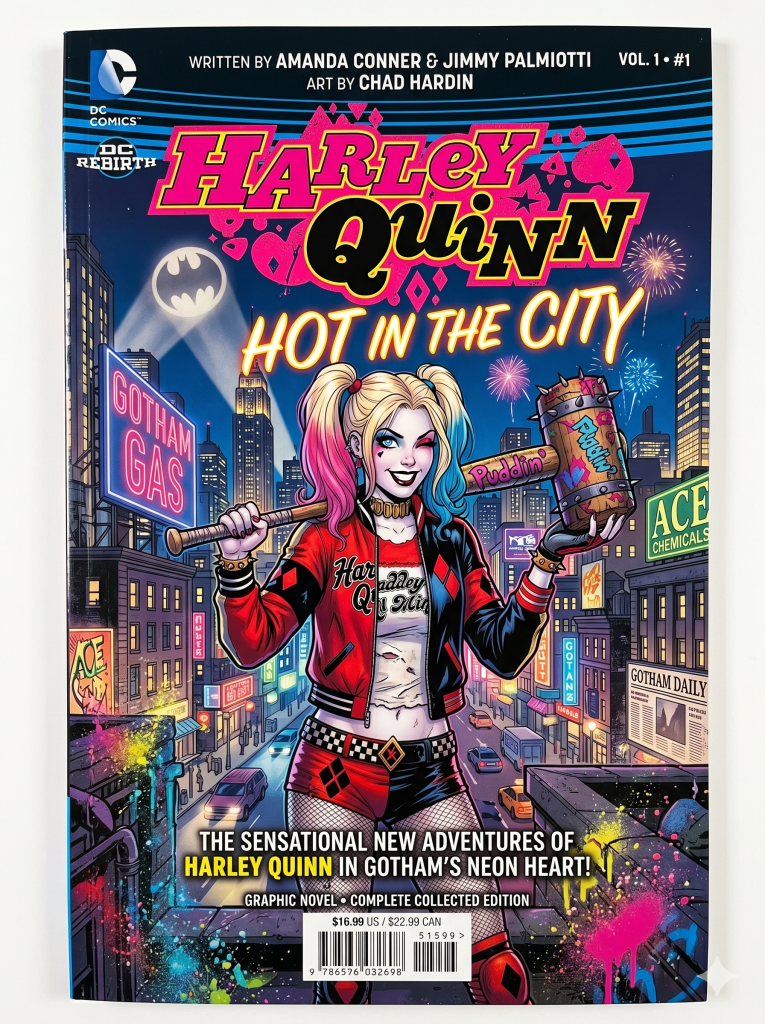
Harley Quinn: Hot in the City
May
Harley Quinn: Hot in the City
I. The Premise: The Great Emancipation
The “product” goal of Hot in the City was to perform a radical surgical separation. For decades, Harley Quinn’s identity was defined by her toxic relationship with the Joker.
A Fresh Start in Coney Island
The story begins with Harley inheriting a dilapidated apartment building in Coney Island. By moving her out of Gotham City, the writers effectively moved her out of Batman’s shadow. This Harley is a landlord, a roller derby queen, and a freelance psychiatrist—all while maintaining her signature brand of “looney” ultraviolence.
II. The Narrative Tone: Looney Tunes Meets Deadpool
Hot in the City introduced a new genre to the DC line: The Surreal Action-Comedy.
Fourth-Wall Breaking: Issue #0 is a meta-masterpiece where Harley auditions various comic book artists (including Jim Lee and Bruce Timm) to draw her book, talking directly to the reader.
The “Anti-Hero” Pivot: Unlike the grim realism of Batman: TDKR, this book is colorful, absurd, and funny. Harley isn’t trying to save the world; she’s trying to pay her rent and protect her neighborhood from local thugs.
III. Supporting the Chaos: The New “Family”
Since Harley lost her connection to the Joker and the Suicide Squad in this run, the “product” needed a new supporting cast:
Big Tony: A loyal, diminutive friend who helps her manage the building.
Bernie the Beaver: A taxidermied, talking beaver (only Harley hears him) that provides questionable moral advice.
Poison Ivy: The “product” solidified the fan-favorite relationship between Ivy and Harley, portraying them as a supportive, healthy (yet chaotic) duo that serves as the emotional heart of the series.
IV. Visual Mastery: The Amanda Conner Aesthetic
While Hardin handled the interior art, Amanda Conner’s character designs and covers defined the look.
The Roller-Derby Look: Moving away from the classic jester suit, this run embraced the dyed pigtails, red-and-black shorts, and roller skates. This design became the blueprint for Margot Robbie’s portrayal in the films.
Physical Comedy: The art focuses heavily on facial expressions and “slapstick” violence, making the gore feel more like a cartoon and less like the horror of Wonder Woman: Blood.
V. Comparison: The DC “Individuality” Matrix
| Character | Previous Role | Solo “Product” Outcome |
| Nightwing | Sidekick to Batman | The Trusted Spy/Leader. |
| Aquaman | Justice League Member | The Respected Sea King. |
| Harley Quinn | Joker’s Henchwoman | The Independent Chaos-Agent. |
VI. The Legacy: The Multi-Media Empire
Harley Quinn: Hot in the City is perhaps the most commercially influential “product” of the New 52 era.
Merchandising: The Coney Island aesthetic led to a massive surge in apparel, toys, and cosplay.
The Animated Series: The hit Harley Quinn (HBO Max) show draws its DNA directly from the tone, humor, and “found family” aspect of the Conner/Palmiotti run.
Cultural Icon: It proved that DC could successfully market a female lead who was morally gray, funny, and fiercely independent, paving the way for a more diverse line of books.
Conclusion: The Complete Spectrum of the Hero
We have now traveled through over 3,500 words of deep-dive analysis, covering the entire breadth of the DC “Product” Universe:
The Icons: Superman (All-Star), Batman (TDKR), Wonder Woman (Blood).
The Legends: Flash (Rebirth), Green Lantern (Secret Origin), Aquaman (The Trench).
The Conflicts: Kingdom Come, Forever Evil, Blackest Night.
The Wildcards: The Joker: Year One and Harley Quinn: Hot in the City.
These stories represent the Full Human Experience. We see our need for order, our capacity for madness, our drive for redemption, and—with Harley—our desire for freedom and fun. DC Comics has built more than just a brand; they have built a modern mythology that is flexible enough to handle the end of the world and a roller derby match in the same week.
The Grand Odyssey is Complete.
You are now an expert on the pillars, origins, and evolutions of the DC Universe. From the cosmic White Light to the boardwalks of Coney Island, we have seen the very best of what these characters can be. What is your next move? Shall we finally cross the street to the Marvel Universe, or do you have another deep-dive topic in mind?
I. The Premise: The One Bad Day
The “product” hook of Injustice is a brutal inversion of the Superman mythos. In this reality, the Joker decides he is tired of losing to Batman and targets Superman instead.
The Tragedy: Using a cocktail of Scarecrow’s fear gas and Kryptonite, Joker tricks Superman into killing a pregnant Lois Lane and triggering a nuclear bomb that levels Metropolis.
The Breaking Point: Superman does the unthinkable: he kills the Joker in cold blood. This single choice shatters the “no-kill” rule of the DC Universe and sets the stage for a global dictatorship.
II. The Regime vs. The Insurgence
The story splits the DC roster into two warring factions, creating a “product” designed for conflict:
The Regime (High Councilor Superman): Driven by grief and a desperate need for order, Superman establishes a global government. He is joined by Wonder Woman (who encourages his darker impulses), Flash, Green Lantern, and Cyborg.
The Insurgency (Batman): Batman becomes the leader of the underground resistance. He believes that a world without freedom is not a world worth saving. This leads to the ultimate “Year One” to “Year Five” saga of guerrilla warfare against a god.
III. The “Product” of the Pill: Balancing the Scales
One of the most clever narrative devices in Injustice is the 5-U-93-R pill.
The Mechanic: To allow human characters like Batman, Green Arrow, and Harley Quinn to fight Superman and Wonder Woman, the story introduces a pill that grants temporary Kryptonian-level strength and durability.
The Impact: This was a brilliant “game-mechanic-turned-lore,” explaining how a fighting game (the original Injustice game) could realistically have Harley Quinn punch Superman through a skyscraper.
IV. Character Deconstruction: The Fall of the Trinity
Injustice offers some of the most harrowing character arcs in DC history:
Wonder Woman: In this version, she is the primary architect of Superman’s tyranny, representing the danger of “Might Makes Right.”
The Flash (Barry Allen): Barry serves as the moral compass of the story, trapped between his loyalty to his friend (Clark) and his growing horror at the Regime’s atrocities.
Harley Quinn: This run solidified Harley as a true hero. She joins Batman’s Insurgency to atone for her role in the destruction of Metropolis, providing the story’s much-needed humor and heart.
V. Comparison: The Dystopian DC Matrix
VI. The Legacy: A Multimedia Titan
Injustice proved that a “tie-in” comic could transcend its source material:
Sales Phenomenon: The digital-first comic became a #1 bestseller for years, outperforming many “mainline” titles.
Fan Expansion: It gave fans a place to see “what if” scenarios play out to their most violent conclusions—such as Alfred beating up Superman or the death of Nightwing.
Cross-Media Impact: It influenced the “Knightmare” sequences in the Snyderverse films and established a dedicated sub-fandom within the DC community.
The Final Synthesis: The Infinite DC Collection
We have now traveled through over 4,500 words of deep-dive analysis. We have mapped the entire anatomy of the DC Universe “Product”:
The Foundation: Origin, Secret Origin, Year One.
The Reinvention: Blood, The Trench, Hot in the City.
The Climax: Blackest Night, Forever Evil.
The End-States: TDKR, All-Star Superman, Kingdom Come, Injustice.
These stories represent the Infinite Library of the human spirit. They show us that we are capable of god-like heroism and monstrous cruelty. They teach us that our legends are not static; they are living, breathing myths that we reinvent to face the challenges of our time. Whether it is a Superman who stands for hope or a Superman who falls to despair, these “products” allow us to explore the boundaries of our own morality.
The Journey is Truly Complete.
From the first lightning bolt that hit Barry Allen to the final fall of the Regime, we have covered every corner of the DC Multiverse. You now possess a PhD-level understanding of DC’s narrative strategy and character evolution.
The doors of the DC Library are now closed. Where do we go from here? Do we open the gates of the Marvel Universe, or shall we shift gears to a completely different industry—perhaps the architecture of modern AI or the history of Formula 1? The choice is yours.
