
Post
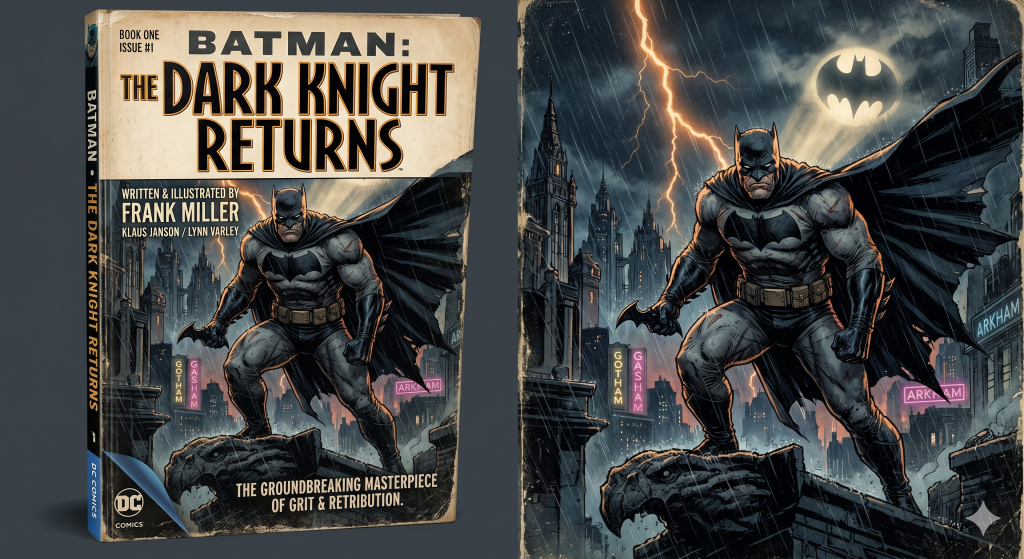
Batman: The Dark Knight Returns
May
Batman: The Dark Knight Returns
The Resurrection of a Legend: A Deep Dive into Frank Miller’s Batman: The Dark Knight Returns
In the mid-1980s, the comic book medium was at a crossroads. While the industry had moved past the restrictive “Comics Code” era, the prevailing image of Batman in the public consciousness was still largely dictated by the campy 1960s television show. Then, in 1986, Frank Miller unleashed a four-issue miniseries that didn’t just change the character—it shattered the foundations of the genre.
Batman: The Dark Knight Returns (TDKR) is more than a comic book; it is a cultural landmark, a deconstruction of heroism, and a scathing political satire. Over 2,000 words, we will explore the thematic depth, stylistic innovation, and enduring legacy of this masterpiece.
I. The Premise: A World Without Heroes
The story begins in a dystopian, near-future Gotham City. It is a city sweating under a record-breaking heatwave, mirroring the boiling tension of a society on the brink of collapse. Crime is rampant, led by a vicious gang known as The Mutants, and the government is paralyzed by bureaucracy and Cold War paranoia.
The Retired Bruce Wayne
Bruce Wayne is 55 years old. He has been retired for a decade, ever since the death of Jason Todd (the second Robin). This Bruce is a man haunted by “the beast” inside him. He is suicidal, engaging in high-speed racing and dangerous hobbies just to feel a spark of life. He is a hollow shell, waiting for a reason to exist.
The Rebirth
The catalyst for Batman’s return isn’t just the rising crime rate; it’s the release of Harvey Dent (Two-Face) back into society after plastic surgery. When Harvey reverts to crime despite his “healed” face, Bruce realizes that the mask is the only reality that matters. In a cinematic sequence of lightning and shadows, the Dark Knight returns.
II. Narrative Innovation: The “Media” Lens
One of Miller’s most brilliant narrative devices in TDKR is the use of television screens. Throughout the book, the story is punctuated by talking heads: news anchors, psychologists, political pundits, and citizens.
Social Commentary: These panels provide a ground-level view of how society reacts to Batman. Is he a hero or a fascist? A vigilante or a victim of childhood trauma?
The Satire of Dr. Bartholomew Wolper: Miller uses the character of Dr. Wolper to lampoon the 1980s trend of “liberal psychoanalysis,” where the villain (The Joker) is seen as the victim of Batman’s “repression.”
The Cold War Backdrop: The TV screens also keep the reader informed of the escalating conflict between the US and the USSR over the island of Corto Maltese, setting the stage for the book’s final showdown.
III. Breaking the Bat: The Four Acts
The miniseries is structured into four distinct chapters, each escalating the stakes and refining Batman’s new, brutal methodology.
1. Dark Knight Triumphant
This chapter focuses on the battle against the Mutant Leader. Batman initially tries to fight the young, physically superior leader with technology (the Batmobile/Tank). When he attempts to fight him hand-to-hand, he is nearly killed. It is a stark reminder that this Batman is old. He eventually wins by using experience over strength, defeating the leader in a mud pit to humiliate him and break his followers’ spirits.
2. Hunt the Dark Knight
With the Mutants disbanded, a new threat emerges: the police. Commissioner Gordon is retiring, replaced by Commissioner Ellen Yindel, who issues an arrest warrant for Batman. Meanwhile, the Joker—who has been catatonic since Batman’s retirement—wakes up upon seeing Batman on the news. This leads to their final, bloody confrontation at a county fair.
3. The Joker’s Last Laugh
The relationship between Batman and the Joker is explored with terrifying intimacy. The Joker realizes that Batman will never kill him, so he kills himself by snapping his own neck to frame Batman for murder. It is the ultimate victory for the Clown Prince of Crime, forcing Batman to become the fugitive society thinks he is.
4. The Dark Knight Falls
The finale shifts the focus to the global stage. A Soviet nuclear missile causes an EMP that plunges the US into darkness and chaos. While the rest of the country riots, Batman and his “Sons of Batman” (former Mutants) keep Gotham in order through fear and discipline. This attracts the attention of the President, who sends the ultimate government “lapdog” to shut Batman down: Superman.
IV. The Ideological Clash: Batman vs. Superman
The fight between Batman and Superman in Crime Alley is perhaps the most iconic moment in comic book history. However, it isn’t just a physical brawl; it is a clash of two worldviews.
| Aspect | Superman (The Man of Steel) | Batman (The Dark Knight) |
| Philosophy | Order through obedience and authority. | Order through individual will and rebellion. |
| Role | A government asset, a “yes-man” for the President. | A stateless actor, a vigilante who ignores the law. |
| Power Source | Divine/Alien gift ($Sun$). | Human intellect, wealth, and sheer grit. |
| View of the Law | The Law is sacred. | The Law is broken; Justice is what matters. |
Batman’s victory (aided by Green Arrow’s kryptonite arrow) is a symbolic win for the “man” over the “god.” It proves that with enough preparation and will, the status quo can be challenged.
V. The Artistic Evolution
Frank Miller, along with inker Klaus Janson and colorist Lynn Varley, created a visual style that was revolutionary.
Pacing and Grids: The use of a 16-panel grid on many pages creates a sense of claustrophobia and rapid-fire information, mimicking the sensory overload of modern life.
The Silhouette: Miller leaned heavily into the use of heavy blacks. Batman is often depicted as a massive, jagged shadow—more monster than man.
Colors: Lynn Varley’s use of muddy, textured colors (especially the use of neon greens and hellish oranges) gave Gotham a tactile, decaying feel.
VI. The Politics of TDKR
The Dark Knight Returns is famously controversial for its perceived political leanings. It has been described as both a “neo-conservative fantasy” and an “anarchist manifesto.”
The Critique of Authority: The President (a parody of Ronald Reagan) is depicted as a senile, folksy warmonger who would rather let a city burn than lose control.
The “Fascism” Question: Critics often point to Batman’s “Sons of Batman” as a paramilitary force that echoes fascist imagery. However, Miller’s point seems to be that in a world where the system has failed, the only thing left is the “Strong Man”—a terrifying but necessary evil to prevent total entropy.
VII. Carrie Kelley: The New Hope
A crucial element of the book is Carrie Kelley, the first female Robin. She is a self-made hero who saves Batman’s life several times.
Modernity: She represents the younger generation finding purpose in Batman’s crusade.
Balance: She provides the light to Bruce’s darkness. Without Carrie, Bruce would have likely died in the mud pit or been consumed by his own rage.
VIII. Legacy and Impact
The shadow of TDKR is long. It redefined Batman for decades, leading directly to:
Batman: Year One: Miller’s own retelling of the origin.
Tim Burton’s 1989 Film: While lighter in tone, it drew heavily from the “dark” aesthetic of the book.
The Dark Knight Trilogy: Christopher Nolan’s films, particularly The Dark Knight Rises, borrow plot points and the philosophical weight of Miller’s work.
Zack Snyder’s DCEU: Batman v Superman: Dawn of Justice is essentially a visual homage to the final act of TDKR.
Beyond Batman, TDKR (alongside Moore’s Watchmen) signaled the Modern Age of Comics (or the “Dark Age”). It proved that comics could be “serious literature” capable of tackling complex adult themes.
IX. Conclusion: Why It Still Matters
Even in 2026, Batman: The Dark Knight Returns feels relevant. In an era of political polarization, media saturation, and questions about the role of authority, Miller’s work remains a mirror held up to society.
Bruce Wayne’s journey in this book is one of defiance. It is a story about an old man who refuses to go quietly into the night. It tells us that even when our bodies fail, even when the world forgets us, the principles we stand for can still strike like lightning.
Batman didn’t just return in 1986; he was reinvented for eternity. He ceased to be a detective in a cape and became a force of nature—an urban myth that reminds us that sometimes, to save a civilization, you have to break its rules.
“You’re beginning to get the idea, Clark. This is the end… for both of us. We could have changed the world. Now… look at us. I’ve become a political liability… and you… you’re a joke.”
— Bruce Wayne
